Monday, March 06, 2006

Hiwar Al-Tourshan!

Today Jumblatt spoke at the Brookings Institute in DC. I was there and heard what he got to say.

In my mind now, I am thinking whether the Hiwar back in Beirut was truely a trap after all, a trap to lure all the players to agree to Hizbullah's terms.

Basically Jumblatt revealed the deal that Hizbullah has put on the negotiating table: They will give up the Presidency, if the March 14 bloc agrees to drop the issue of the Shebaa Farms, and by that agreeing to the continuation of Hizbullah's resistance role.

If that's the deal put on the table, well, Jumblatt has revealed it to all of us. He is here, in DC, invited by the U.S. Administration so they could listen to his point of view. When asked what would he demand of the U.S. Administration, he said that as a free Lebanese citizen, he will ask for support to continue on with the Cedar Revolution, namely support through pressuring the Syrian regime diplomatically and economically in order for its President to recognize that Lebanon is a free, sovereign country and that it should be left alone.

Such tough language towards the Syrian regime would not have come if it wasn't for the Syrian President's talk aired yesterday evening on Lebanese TV. President Assad talked at length about his opinions towards the outcome of the Lebanese dialogue that is taking place right now in Beirut. He said that those at the meeting should come out of the dialogue with "black and white" answers to important issues about the Resistance and about the Lebanese-Syrian relations. Bashar had the audacity to even defend the "lame duck" Lahoud and explain why he has called for renewing his term (because he defends the Resistance and has helped Lebanon not veer away from its Arabist agenda!). But what shocked me the most was when he said that this ongoing dialogue will determine where each party stands. He has already decided that this dialogue will lead to polarization!


أنا لا أرى أن التيار القومي والمقاوم سيذهب باتجاه أن يقول اننا نعم اتفقنا على قبول التدخل وعلى حل سلاح المقاومة وضرب العلاقة مع سوريا. إما أن تأتي الأمور بهذا الاتجاه وإما أن يكون هناك انقسام وفشل كما سميته الفشل الذريع


My question is why is President Assad doing what the Syrian regime always did, namely dictate to us what needs to happen and what needs to be? We say: President Assad: Leave us alone!

But to return to the issue of whether this Lebanese dialogue has been sabotaged, I was thinking how on the first day of the dialogue, Parliament Speaker Berri was quick at publicizing to everyone that all players have agreed that the Shebaa Farms belongs to Lebanon. Yet, Jumblatt, since he left the country, has questioned this premise, including his representative at the dialogue table, Information Minister Ghazi Aridi.


إنه ليس صحيحاً على الإطلاق أن اتفاقاً تم بالإجماع حول لبنانية مزارع شبعا، أبداً
أبداً. هذا الموضوع كان حوله نقاش، لكن لم نصل الى اتفاق حول تثبيت لبنانية مزارع
شبعا بقرار بالإجماع، وهنا لا بد من الانتباه الى هذه المسألة، فالحوار ما يزال
مستمراً بأجواء هادئة وصريحة


Which leads me to believe that in reality, nothing has been agreed on yet.

Publicizing that all have agreed that the Shebaa Farms are Lebanese, was a clear signal to Syria that it can relax about the urgent demand to demarcate its borders with Lebanon and a clear signal that Hizbullah's arms are there to stay. Interestingly, in the newspapers we read today that Syria's Foreign Minister Moallem has reiterated that the Shebaa Farms are Lebanese. We say: Can you please head to the UN and provide the proof once and for all and relieve us of our chagrin?

After I attended the Jumblatt event, I quickly returned to watch the Lebanese news. Already reporters were hailing a flurry of questions on the politicians involved in the national dialogue, asking them whether Jumblatt's request for U.S. help is a blow to the dialogue. The politicians said that they need to read his statements first, others said that all is being discussed on the table...

Jumblatt was clear; he said what many Lebanese are thinking and feeling, what many Lebanese aspire for regarding their country. We want an independent, free, democratic Lebanon, a Lebanon with a Lebanese agenda, and a President with a Lebanese agenda who is the final arbitrator amongst all factions and parties. Lebanon cannot solve the Arab-Israeli conflict; at least it cannot do it through violent means. Lebanon cannot defend any country's nuclear arsenal. Lebanon cannot defend a dictatorship against another. Lebanon needs a state that is sovereign, able to defend its territories when needed, without the need for others' arms on its land.

Naseer As'ad wrote today in Al-Mustaqbal, trying to draft a win-win scenario for this ongoing dialogue. He claimed that perhaps a "road map" can be devised where Hizbullah will disarm gradually, within a certain context of the Taif Accord and UNSCR 1559. I couldn't finish reading!

I'm aware that if this dialogue comes out with positive outcomes, Lebanon will be better off and Lebanese will be better off. Nothing can be solved in day or two; everything takes time. But right now, there is so much going on for me to be able to process at once. I'll wait a day or two...before making up my mind.

"Nobody knows how many rebellions, besides political rebellions, ferment in the masses of life which people earth."

Sunday, March 05, 2006

Lebanese Engineers in the Gulf

Almost as if on queue, I bumped into this interesting piece of information:

In January of 2006, the Khaleej Times interviewed a high-ranking member of Lebanon's Contractor Association by the name of Sa'did Fathah. Mr. Fathah claims that over 9,000 Lebanese construction engineers are currently employed in the Gulf, and that 3,000 of those were hired in either 2004 or 2005.

Of course, statistics in Lebanon are almost unheard of... so this man's claims stand out because he presents numbers. But, to be honest with you, the impression I get is that the numbers he presents are quite miniscule.

Lebanon... the hospital of the Middle East?

In times like these, when Lebanon's head political honchos are sitting around a table with the express intent of preventing a civil war, economic news may seem a little mundane! But no matter what the eclectic collection of god's representatives on Earth like to preach, money makes the world go round, and therefore, matters of the "Green" always deserve their little space in the headlines.

Last week, the Clemenceau Medical Center opened its doors in Beirut. It is the first clinical facility in Beirut that is affiliated with Johns Hopkins Medicine International, or indeed any other international organization of such caliber. The press release that was issued on the day of the opening read as follows:

CMC aims to be the creator, applicator and the forerunner of a new healthcare concept in Lebanon and the region. The Center is a unique health complex with a multipurpose high-tech hospital, fully-equipped with International standards.... CMC has the facilities and services to cater to the needs of patients from Lebanon and the Middle East. Virtually, all medical services a patient might need - doctor visits, testing, surgery, and hospital care - are available under one roof at CMC....
Sounds great, doesn't it? Except I wonder where all those Arab patients are. From what I hear, Lebanese doctors have formed little "mafias" to prevent new entrants into their field of specialty and protect what little clientele they already have... most of whom are Lebanese!

It is obvious to all of us... Lebanon's potential lies in the medical field. Yet, for some reason the political elite has not exploited that potential! Every mom and pop in Lebanon grooms their children to become either engineers or doctors... and the glut of professionals that this Lebanese obsession has created in both fields is immense! However, whereas engineers actually need to go somewhere to build a structure, or do whatever it is they specialize in, patients usually come to doctors! And the all mighty knows, Lebanon has a lot of doctors!

Where are those patients?!?!?! Why isn't the Lebanese government taking more steps to facilitate the process of traveling to Lebanon for a bypass heart surgery? Why hasn't Lebanon become the hospital of the Middle East? Oh wait... I know... we're too busy dealing such life and death issues as the Shebaa farms, and inter-sectarian one-upmanship!

Another top ten list Lebanon can be proud of

The Associated Press has released a top ten list of the most "lucrative" bank roberies in history. Yup, you guessed it, Lebanon has its place secured in this ominous list... Just scroll down and check it out! On another note, notice how four of these heists took place in England, and that even the Beirut heist was at the British Bank??? hmmm...

  1. $900 million in U.S. bills and as much as $100 million worth of euros Iraq Central Bank, Iraq, March 2003. The thefts took place at the beginning of the U.S. invasion and were blamed on members of Saddam Hussein's family.

  2. $92 million Security company cash center at Tonbridge in Kent county, southern England. The Bank of England said Feb. 22, 2006, the robbery had occurred overnight.

  3. $70 million Central Bank in Fortaleza, Brazil. Theft occurred sometime during weekend of Aug. 6-8, 2005.

  4. $65 million Knightsbridge Safe Deposit Center, London, July 12, 1987.

  5. $50 million Northern Bank, Belfast, Ireland; Dec. 20, 2004. Widely blamed on the Irish Republican Army.

  6. $37.5 million in gold Brinks Mat Ltd., Heathrow Airport, London, Nov. 25, 1983.

  7. $30 million Bank of France, Toulon, France, Dec. 16, 1992.

  8. $21.8 million Brink's Securmark, Rome, March 24, 1984.

  9. $20 million to $50 million British Bank of Middle East, Beirut, Lebanon, Jan. 22, 1976. The theft took place during the Lebanese civil war and was widely blamed on PLO factions.

  10. $15 million in certificates of deposit Bank of Sepah-Iran, London, January 1983.

Thursday, March 02, 2006

Lebanon: To Be Or Not To Be?

It's not Lausanne, not Taif, not in Damascus, nor in Cairo...It's in Beirut where the Lebanese leaders are meeting to determine the fate of our country. This is new. And interestingly, it's in the heart of Beirut, that heart that was flattened during the war, where they are meeting to determine that fate.

Will they come out with a document that paves the way for instituting the Third Republic? Or will they agree to finally and at last fulfill the mandates of the Taif Agreement that brought about our Second Republic?

Many questions; the fate of this country does rest on the outcome of this meeting. If this meeting fails, we have much to lose. What will the leaders who supposedly represent us decide? Will they decide to agree and save this country or will they disagree and then what?...we enter into the unknown?

And if this meeting fails, it will be even more depressing to see that perhaps Lebanon as a country, as a nation, is a failed idea. Because when the Lebanese are sitting face-to-face without foreign interference on Lebanese soil, they cannot agree on the basics?! Then what is the message we are sending to ourselves and to the world? Then why would anyone be on our side and why should I continue carrying the banner of Lebanon?

But of course if those leaders dialoguing right now come out with a positive outcome, it will be truely a "victory", even if it was symbolic, that Lebanon can be.

We can make fun of the characters taking part in this dialogue; we can mock the dialogue itself as much as we want, but I believe that history will only tell that what Lebanon is undergoing is historical indeed and worth witnessing in earnest.

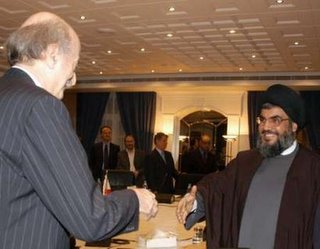
On a lighter note: Check it out this picture from today's meeting:

"Nobody knows how many rebellions, besides political rebellions, ferment in the masses of life which people earth."
8 Oranges

In a somehow pioneering idea for Lebanon, some supporters of the FPM have started a major effort to offer multiple services and products in the Lebanese market, under the umbrella of 8 Oranges. They officially declare that a portion of the profits goes to the FPM.

There is a similar, obviously more developed, experience in Italy, where the Lega (League of Cooperatives) is associated with the Left parties, the ConfCoop (Confederation of Cooperatives) is associated with the Catholic center-right parties, and AGCI, the Association of Cooperatives, quite small compared to the other two, is associated with the Republican parties. Some of these also include agricultural COOP's and the like, but I'm interested in the markets. Any info is welcome. I asked some friends living in Italy and they told me that the hard line supporters of each party shop exclusively at their party’s market, while other people go for the best deals.

Back to 8 Oranges, their services include fuel, water, kiosks, and a loyalty card with which you get insurance… Check the site.

Wednesday, March 01, 2006

Nassib Lahoud For President!

Nassib Lahoud has announced his candidacy for the Presidency, if the March 14 bloc supports his candidacy...or else, he would support any candidate that the bloc backs.

I personally support Nassib Lahoud for President!

"Nobody knows how many rebellions, besides political rebellions, ferment in the masses of life which people earth."

Sunday, February 26, 2006

New TV

New TV news editors should really get a life. I had heard much about the remarks they make during their evening news and I am already sick of the propaganda/filtering/selectivity on Future and LBC, so I thought I’d give NTV a try. I picked the worst day, which was when Rice came to Lebanon.

NTV actually dedicated more than 10% (3 - 4 minutes) of their evening news duration to the bashing of PM Saniora for, get this, kissing (on the cheeks) Condi Rice. Around the end of the news, there was a banner at the bottom of the screen “Hajj Fouad kisses Miss Condoleezza”.

So I stayed and waited, the news item went on something like this:

“PM Siniora insisted today on kissing US Secretary of State Rice on both cheeks……” then some more talk about personal remarks during the visit and then “Just a reminder, people coming back from the pilgrimage to the holy sites should refrain from touching women.”

Again, NTV people. Get a life.

Found on Tayyar.org


The FPM site has this small announcement in the right-hand column.
Roughly, it translates "To our people who have sought asylum in Israel, please email returninghome@gmail.com for help in the return to Lebanon."

Friday, February 24, 2006

The Price of Politicizing Religion

Over the past three or four decades, Islamic “vanguards” have successfully propagated their notion of political Islam. According to these radicals, Islam offers solutions to such wide-ranging problems as the Arab-Israeli conflict and the very practical matter of putting bread on the table. Unfortunately they have successfully convinced considerable portions of Muslim populations all around the world to buy into their rhetoric. These societies have offered such organizations as Hizballah, Hamas and the Muslim Brotherhood legitimacy and authority that any secular leader or party would salivate over. What the average Muslim did not expect was the price their religion would have to pay for this process of politicization.... Thus far, that price has been extremely high, despite the fact that political Islam has only picked up steam in recent years.

Politics is universally referred to as a "dirty game." It is referred to as such for a good reason too. Politics is usually a no-holds-barred slugfest between the powerful, where almost no position or principle is too sacred to compromise or be trampled over. That is the nature of the political game. It has been as such since time-immemorial and will remain as such until the time of men on earth has come to an end.

Through politicizing Islam, Islamic radicals have subjected the religion they purportedly love so much to the nature and whims of politics. The prophet Mohammed no longer remains a religious figure who inspires reverence among believers and a mysterious curiosity among nonbelievers. Rather, the prophet becomes a political figure who is revered by his followers but despised by those who stand to loose from the agenda they perceive him to espouse.

Another contentious issue becomes who decides what is politically "holy" and what is not? A very good example of such a "conflict of holiness" manifested itself in the February 14 demonstration when Walid Jumblatt proclaimed that "their holy causes are illusions...." Of course, Hizballah’s leadership thought that by covering "the resistance" with a shroud of divine legitimacy, they would protect themselves politically. But alas, they miscalculated, and the nature of politics overruled their religious assumptions. The question to ask today is who do you blame: Hizballah for using Islam to legitimize its political position, or Jumblatt for doing what politicians do and openly disagreeing with Hizballah's "divine" position?

As the disturbing events in Iraq over the past few days have proven, even religious sites are not immune. The al Askariya mosque was targeted because of its political value. Had religion been irrelevant in Iraqi politics, why would mosques be targeted in the first place? Furthermore, if the al Askariya mosque was targeted, what is to stop Mecca from being targeted in the future? The politicization of Islam politicizes Islamic holy sites as well. Consequently, today (politically speaking), Mecca has become the equivalent of White Hall in London, the Bundestag in Germany and Congress in the United States.

There is a very famous cliché that most of us have heard: "nothing is for free!" The price of politicizing Islam will be extremely high on the religion itself. The insults will continue, the destruction of mosques will not abate, and the whole notion of “holiness” will lose its meaning since so many people will attribute it to so many different contradicting political causes. I doubt this is what most Muslims want for their religion. In fact, I doubt this is what any faithful person wants for his or her religion. I was raised to believe that religion is above politics. Maybe I am different; but considering the costs of the politicization of Islam, I believe that faithful Muslims should reconsider their support for Islamic radicals who seek political prominence by raising the banner of Islam.

Thursday, February 23, 2006

Lahoud on the way out, but not quite there yet..

Secretary of State Condoleezza Rice's choice to hold her first meeting with the head of Lebanon's Catholic Maronite Church is indicative of the current U.S priorities towards Lebanon. The Patriarch plays a central role in determining the fate of the presidency and has only recently moved to de-legitimize President Emile Lahoud's mandate. Equally telling is her decision not to meet with the Pro-Syrian Lahoud as she had done on her prior visit.
.
Now that Patriarch Sfier has clearly stated that current conditions surrounding the presidency must not continue, the debate between pro and anti Syrian parties is likely to shift from whether or not to ouster President Lahoud to trying to find a compromise candidate. Yesterday's visit by the Qatari Foreign Minister to Beirut and Damascus may be an attempt to broker such a compromise. It is not entirely unimaginable that Damascus might try to bargain and compromise over Lahoud's fate rather than wait until next year and see his term expire in return for little.
.
In any event although it's not quite a done deal yet, Lahoud seems to be on his way out. It is increasingly unlikely that he will remain in office until the end of his mandate, but domestic and regional negotiations regarding a replacement may take weeks or even months.
.
We will retain the pleasure of having him in the Presidency (sarcasim of course) as the March 14 deadline comes and goes.

Wednesday, February 22, 2006

From Baabda To Mathaf: First Things First

Per protocol, the Cabinet will convene tomorrow Thursday evening, but this time around not in the Baabda Palace, but in a temporary location in the Mat'haf area in Beirut.

Why? The majority of the Cabinet ministers unanimously agreed not to visit Baabda while Lahoud is in power.

The first, tangible steps taken by us, Lebanese, to say: Lahoud, Tla3 Barra!

But there's more: Parliament Speaker Nabih Berri has been sending invitations to prominent heads of parties and parliamentary blocs to join the negotiation table (tawilat al-hiwar). President Lahoud is not invited! He, unfortunately, does not even qualify to play the role of the national mediator; he has taken sides far when he endorsed the Ain El-Tineh Gathering last year.

Our President has truely lost his Lebanese legitimacy!

"Nobody knows how many rebellions, besides political rebellions, ferment in the masses of life which people earth."

Arabs and Muslims should look at the mirror more often!

The attack on the Askariya Shrine in Iraq today is another major blow to the Arab and Muslim propaganda machine that has struggled for decades to draw the world's attention solely on Israeli infringements of Palestinian rights and, more recently, the "Western" attack on Islam.

When this propaganda machine screamed that Arab-Israelis were treated as second class citizens, all we had to do was point to the Copts in Egypt, who up to this day cannot even build community centers because their Muslim neighbors will suspect that they are building churches....

When this same propaganda machine screamed that the Israelis ethnically cleansed Palestinians from their homes, all we had to do was point at Saddam's actions towards the Kurds and the Marsh Arabs, who were victims of systematic ethnic cleansing campaigns....

And now, when this propaganda machine screams that the Israelis and the West are deliberately targeting Islam by desecrating its prophet and holy sites, and plotting to blow up the Dome of the Rock or nuke Mecca, all we have to do is point to al Qaeda - the only organization on this Earth that has successfully managed to blow up one of Islam's holiest sites!

Typical Arab Response: Hey let's go protest against those damn Danes, and destroy some Churches while we're at it!!! What do you say?!?!

Tuesday, February 21, 2006

Fellow blogger creates new and improved website

Fellow Lebanese Blogger Qais has just changed his url address to http://www.beirutbeltway.com/

His new website is definitely an improvement over the old one, so the change was definitely worth the inconvenience that comes with a different url.

To sweeten the medicine a little, Qais has also published an entry concerning threats that the Dailystar recieved from the Syrian Mukhabarat to publish those ridiculous Op Ed pieces that Butheina Shaaban wrote.

Check it out!

Monday, February 20, 2006

A Year Since We Started Writing...

I remember a year ago, Raja and I were boiling with energy...we wanted to take action. There were people on the streets in Lebanon, and we were here stuck watching TV. We wanted to take action, to take part in history-in-the-making.

Raja called me at work and told me to start writing; he set us a blog. I was reluctant to write, knowing that once you write something on the blogosphere, you are exposing yourself to the whole world. Yet what is interesting is that there is instant gratification in receiving comments from readers and by that creating dialogue and conversations we so much needed while away from the homeland.

I opened up and started writing. My first post is entitled: My Thoughts. Dated February 21st, 2005.

We started by inviting other friends onto this blog: Reem, Firas, May, Hassan, Hani G, Lea. Some wrote, some commented, some left us, but Raja and I continue to feel an obligation to write. Our circle of friends have widened, friends we made through this blogosphere, friends whom we would not have met ever if it was not for this venue. I can say that through this blogosphere, we have created a new "community" of Lebanese open to dialogue, willing to bounce off ideas and to expose their beliefs and thoughts for criticism and further analysis.

For a year now, we've witnessed the ups and downs of politics in Lebanon, being reflected on this blogosphere. So we've seen it through the rough tides. And we continue to have hope. I believe that hope is what characterizes our spirit and outlook towards Lebanon. After all, we want to return to Lebanon and this blog is one of the tools of engagement.

I want to thank everyone who continues to read our posts. You are what has made this blog make it through its first year. I want to also thank our fellow bloggers and my fellow writers on this blog.

And finally, a large, special thanks to Raja. Happy Birthday! Looking for another year of the same!


"Nobody knows how many rebellions, besides political rebellions, ferment in the masses of life which people earth."

Happy Birthday!

I just wanted to announce that today is this website’s first Birthday. Yup, this blog is officially a year old! When it actually dawned on me that we reached that milestone, I couldn’t believe it! I never thought we would last this long…. I never thought I could last that long! I have to extend my gratitude to all of the Lebanese bloggers, commenters and visitors for keeping this blog and the Lebanese Blogosphere alive. We have all taken part in creating something new… we have helped to enrich Lebanon’s presence on the World Wide Web, and created a new medium for Lebanese across the sectarian divides and from all over the world to communicate through. We have essentially created Lebanon’s little space in the World Wide Web.

The first bloggers I discovered that remain active today were Tony at Across the Bay, Mustapha at Beirut Spring, LP and CG at Lebanon Political Journal and the guys at The Lebanese Blogger Forum. Today the Blogosphere grows on an almost monthly basis.

Lots of blogs came and went, but some stayed with us. From Beirut to the Beltway, Letters Apart, Lebanonesque, Welcome to my Dream, Cedars Awakening and Ms. Levantine are all blogs that I discovered along the way and continue to visit as they post more entries. New blogs have also emerged more recently. Beirut Notes and Jamal’s Propagandas Site come to mind, so does the infamous ;-) French Eagle! The Lebanese Blogosphere has also been enriched with the words of foreign bloggers who share with us a passion for our country and region.

Stacey continues to provide us with her insightful entries; Michael Totten's blog is always a treat to visit, and Joshua Landis.... Ohhhh… Joshua Landis. Where would the Lebanese Blogosphere be without Joshua Landis??? the blogger who eventually turned himself into the Lebanese piñata, and at a certain point in time inspired around half of our entries (which were written in response to some of his provocative and, to put it mildly, pro-Bashar entries).

Partially thanks to this spur of activity in the Blogosphere, the World Wide Web now hosts new websites such as Ya Libnan and The Lebanese Lobby News Website. Ya Libnan started off as a blog and is now a full-fledged news website. The guys at the Lebanese Lobby also do a great job at keeping all of us informed about Lebanon and Lebanese who live and work abroad.

And finally, let me just say that nothing sustains the Lebanese Blogosphere like OpenLebanon.org. The website that does so much, and can do so much more!

Guys… let’s all keep this up! I look forward to more blogs and websites. Lebanon, with all its wonderful diversity and painful contradictions is finally exposing itself to the world through the World Wide Web. In this case, all I can say is the more the merrier… so bring ‘em on! :-)

Don't overblow Lebanon's Democratic Problem!

Some in the Lebanese blogosphere have proclaimed the consensus candidate for Ba'bda Aley as a 'cataclysmic' blow to democracy. I respectfully disagree; but even if I did agree with that assessment, so what???

Lebanon's problem is not related to democracy. I repeat... Lebanon's problem is NOT related to democracy. Maybe the Syrian and Saudi problem is their lack of democratic institutions, but the Lebanese problem is not. Every democracy on this Earth possesses authoritarian elements - elements that thwart the "democratic will."

In the United States, you have the Supreme Court, the court system and the US Constitution, all of which form essential components of the "checks and balances" system, which was explicitly designed to thwart the democratic will. A less intentional and more sinister authoritarian element in the United States is the duopoly of the Republican and Democratic parties, and the fact that the system is extremely friendly to incumbents. I'm not too sure about numbers, but it is a well known fact that only an extreme minority of seats in both houses of Congress are actually contestable. The rest of the seats… well, just take a good look at Ted Kennedy.

What do the theorists say about this? Well, they don’t seem to agree. Democratic theory is more like a spectrum than anything else. On one end, are those theorists who claim that a democracy should amount to nothing more than "competition between political elites," in which the only democratic institution available to the regular citizen is the right to vote. On the other end, are those theorists who claim that the vote is inherently undemocratic because it delegates politics to "representatives," as opposed to maintaining it in the hands of the citizen.

I tend to agree more with those who claim that democracies should be limited to a competition among members of the political elite, in which citizens hold them accountable for their performance. Consequently, I disagree with those who assert that the major problem in Lebanon is its democracy (or, a lack thereof). Rather, I argue that the real problem lies in Lebanon's authoritarian institutions (the authoritarian elements within the country’s democratic system).

For example, rather than rely on the Supreme Court for checks and balances, we rely on the Sects to balance each other out. And, rather than rely on the institution of meritocracy, we rely on nepotism. And rather than rely on a secular code of laws that regulates the “personal status” of all citizens, we rely on religious courts that pay no respect to individual rights and other modern rights such as those pertaining to women.

Therefore, the calamity in Lebanon does not lie in Ba’bda Aley or the country's democratic system. Arriving at a consensus candidate is a normal development in all democratic systems. In Lebanon, the real calamity lies elsewhere….

Friday, February 17, 2006

Headed for the slopes, my friends


I am off to the slopes of West Virginia! Will be back on Sunday.

See you all later!Posted by Picasa

Update:

I just got back. It snowed, the temp was bellow 10 fahrenheit ( - 12.2 celsius), and it was windy. Despite those murderous conditions, I had fun!

A couple of words about the slopes. First, they are called "Timberline". For those of you who have been to Farayya in Lebanon, a good comparison would be Junction! I basically snowboarded on one hill that was maybe twice as wide as Junction and 1.5 times as high.

What I found really cool though, was that people skied and snowboarded on 6 or 7 paths that were cut through the forest which covers the hill. So I had really tall and dense forest on either side of me all the time. That experience was both new and fun.

Cool Stuff! Definitely not Lake Taho nor even Farrayya... but, cool stuff!

Now, back to the grind!

The Outcome Of February 14 And The Strong State

Has the February 14 rally in Martyr's Square made a difference on the political arena in Lebanon? And are we seeing the results of gathering hundreds of thousands on the streets that day paying off?

Well, perhaps we are witnessing a change!

First, Aoun met with the Lebanese Forces MP Adwan yesteday in Rabieh to discuss the list of potential candidates that can be agreed on for the upcoming Baabda/Aley elections to fill the vacant Parliamentary seat that the late MP Edmond Naim left behind.

Aoun and MP Adwan have been meeting since Aoun returned to Lebanon. But what was so different about yesterday? In a press conference, Aoun announced that his bloc and the Lebanese Forces will disclose on Sunday the name of the candidate they agree on; they are giving themselves until Sunday to decide on one.

So how come now Aoun is negotiating with the Lebanese Forces on this Parliamentary seat, when two weeks ago, Aoun blurted that this particular election race will be negotiated between his bloc and the Future Movement, and by that totally disregarding the Lebanese Forces, which in reality had won this seat during the past Parliamentary elections? Was this new move a sign that Aoun recognizes the popular weight of the Lebanese Forces, after it succeeded to bring thousands upon thousands of its supporters out on the streets last Tuesday?

Second, yesterday Sayyid Nasrallah started out his speech in UNESCO with a conciliatory, soft-spoken tone. He said that he supports the importance of dialogue and that the resistance has always fought for Lebanon (al-watan) and will always do. He even denied that Hizbullah is affiliated with the Syria-Iran axis and that reports claiming that he said Hizbullah's arms are tied to the regional settlment with Israel are twisted and not entirely true!

We can take from his conciliatory tone that Hizbullah is open for dialogue and will negotiate on its arms. A direct result of February 14? I'm sure, some would agree and some would not.

But to move to another point regarding Nasrallah's speech: Sayyid Nasrallah said that he supports a "strong" state, a state with "strong" strategic policies. I asked myself, what he meant by "strong" and whether the Lebanese state could ever be "strong" in a foreign-policy sense (which is what Nasrallah is alluding to).

Is it that what he means by "strong" strategic policies, is basically facing up to the West? Does it mean that the Lebanese state should ally itself with the axis of "Ghaza, Lebanon, Syria, Iran, Venezuela" (as Sayyid Nasrallah described in his speech, this axis versus the Tel Aviv-USA axis)?

Lebanon, in my view, cannot be a strong state in that sense. Neither its size, nor its "coexistence formula", let alone its democractic political orientation, will land us a strong state with provocative strategic stands.

Our state can and should be "strong" in attempting to forge a unified notion of what constitutes a Lebanese citizen. This is where the state plays an important role, a role our state has not played successfully since its inception.

"Nobody knows how many rebellions, besides political rebellions, ferment in the masses of life which people earth."

Thursday, February 16, 2006

Such a long meeting!

Today on LBC, I watched a report that covered Seniora's visit to the Vatican. Something caught my attention about the report. LBC insisted on inserting the following into its report:

Seniora met the Pope for 30 minutes, which is unusual because the protocol calls for meetings to last for five minutes only.
LBC then reported that
Seniora went on to meet the Vatican's Secretary of State, in a meeting that lasted for 50 minutes, which was also unusual because protocol also calls for meetings to last for (if I remember correctly) five minutes.
Interesting, no? Of course, LBC could have chosen not to mention those nuances, just like Future TV chose not to mention that the Iranian official visiting Lebanon paid Hariri a visit. By the way, one of my favorite past-times has become watching Future and LBC and comparing the coverage of the same events. I just love doing that.

But going back to Seniora's meetings, and disregarding the question of LBC's coverage... Why were those meetings so long? I've heard of previous political roles that the Vatican played in the past (e.g. intermediary, messenger, etc...). Could they be playing one of those roles today?

Oh I know, they were probably trying to appeal to Seniora's Italian roots to do them a favor or something of that nature. Italian roots you ask... Well how do you think he got that last name???

Totally Different Subject...

I find it fascinating when Hizballah claims that no such thing as a Damascus-Tehran-Hizballah alliance exists on the very same day that the Iranian foreign minister visits Lebanon. How blatantly could your lie be?!?!?! C'mon tell the Iranians to come a week later or so, so that what you said may sort of fade in our memories...

And Finally...

I noticed that Nasrallah reaffirmed Hizballah's God-given right to resist. Okay, no comment... except of course, this is just one example of the problem that accompanies the participation of religious men in politics.