It's been a year now, since Lebanon has brandished headline news on American newspapers. Today, as I grabbed the "Express" (a shortened version of the Washington Post), I saw a picture of a protester with the Shahadatan banded around his forehead and the familiar Tabaris building burning behind him.
What happened yesterday was at best surreal. An event of hatred that was uncalled for. It's as if the hands of those who want to break Lebanon are itching for yet another plot to break us, break our will of living free, free of hate, fear, and death.
It's been a year, a year of tests, one after the other...but how much can the Lebanese take. The anger I saw on the faces of the Achrafieh residents made me realize that patience has limits...and I cannot blame them.
Whether in Tripoli or the South, there are hundreds of churches and mazars, never thrown stones at, never ravaged in such a way. Why this time around? Why are Tripolitans driving all the way to Beirut, to throw stones at cars in a Christian neighborhood?
If this angry mob should hurl stones at, it should be my house; because I'm a Muslim who disagrees with their way. This angry mob did not need to go as far as the Danish Consulate to burn it; they should have just turned to cars and houses in their neighborhood...because hundreds of Lebanese have let the issue of the cartoons go...there are more pertinent issues in life to worry about.
There are two news items that gave me the shivers yesterday: one when a number of Sunni clerics rushed to Bkirki to denounce such violence and then conducted their prayers from there...
The second was when Interior Minister Sabeh announced his resignation. He said that since he took over the Interior portfolio, the political and security command structure have not been centralized. And then he confessed that he would never have ordered the shooting at civilians and no one in his position would have taken such action.
I agree with him and applaud his bold move. If this angry, barbaric mob was shot at, then imagine what would have happened; perhaps then instead of stones being hurled at the Achrafieh residents, we would've witnessed a massacre. This is exactly what those "agents" who were causing this violence were waiting for...and we did not give it to them.
You know? At AUB, in a U.S. Politics course I took some six years ago, we learned that the Americans have come up with a term of what is "American" and what is "unAmerican". I believe that what happened yesterday is "unLebanese". The freedom to protest is "Lebanese" and I was proud to hear this right being reinforced on TV over and over. Clerics standing on police cars to stop the uncontrollable mob from causing harm to a church, is "Lebanese". But hurling stones at churches, burning buildings, and harrassing and injuring people of other sects is very "unLebanese".
Yesterday, an Achrafieh resident said that he would have joined the protesters in voicing their contempt against depictions of the Prophet, but he was shocked when he saw destroyed mazars. This is a red line, he said, and then he went to ask: Why?
And again on that same day, on the music talent show Super Star finale, we saw women brandishing the Saudi flag, which was used early that day to justify barbarism and violence, in support of a Saudi contestant.
This is Lebanon for you: we have confused the world. Are we westernized or not? Are we civilized or not? Should they support our cause for freedom or not? Well, today, many around the world are confused by the headlines coming from Beirut.
And those who hate to see Christians and Muslims united for a free Lebanon have shown their face and intentions yet again, and they are getting better at it.
"Nobody knows how many rebellions, besides political rebellions, ferment in the masses of life which people earth."
Monday, February 06, 2006


Sunday, February 05, 2006
Okay this has gotten ridiculous!
The Lebanese have now torched the Danish consulate! I am yet to find out who organized this protest. Was it the Lebanese Basij or some al Qaeda-inspired Sunni group, or maybe some sort of warped coalition between the two?
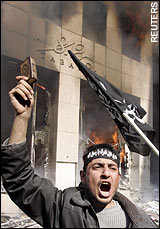 Some report that 20,000 were involved! Moreover, after torching the Danish consulate, they went on satiate their appetite for destruction by torching shops, restaurants and cars in Achrafieh.
What a peace-loving people!
Oh how they respect their neighbors and fellow compatriots!
What a perfect example of "co-existence"
What a wonderful depiction of how backwards our society is!
A Danish artist decides to utilize his modern right of freedom of expression to express what he felt about Muslim terrorism, and Muslims respond like this! The Danes don't need cartoons anymore, all they need to do is to watch their TV sets.
One irony chokes me up more than all the others: The Arab-Muslim world as we know it today is almost completely subsidized by the West.
Arab Muslims are employed by European countries, and then send their remittances home. Arab Muslims also recieve humanitarian and economic aid from Western countries. But most importantly, Arab Muslims (and Persian Muslims) sell oil to the West... oil that is drilled and refined using Western technology and know-how (and, until recently, labor). It is this oil money that then subsidizes the Persian and Arab societies that we live in today.
I don't know if I will ever forgive the West for this addiction of theirs!
Update: The interior minister has submitted his resignation to the cabinet. He claimed that he did what he could to control the protests, but would not order the security services to open fire on Lebanese citizens.
This is good news. Any peaceful resignation of officials that sets an example for the Arab world is a good development. The caveat I have for this particular resignation is that a more competent individual takes his place, and that corresponding political consensus concerning security issues follows.
According to Mr. Saba', there were 1,200 Policemen deployed in Achrafiyeh at the time, and 1,700 army personnel. He also claimed that around a third of those arrested thus far are Lebanese, another third are Syrians and the final third are either Palestinian or claim to belong to Beduin tribes without nationalities.
With regards to the security arrangements taken, I have a couple of words to say: I am no expert on matters of riot control or security affairs, so I may be wrong if I claim that 2,900 security personnel deployed to control a mob of 20,000 seems a bit parsimonious! However, I have seen on TV, and I am sure most of you have too, that the overwhelming majority of those men in uniform are not equiped with riot gear, but rather are thrown in the melee with nothing but M-16 rifles.
Troops carrying rifles sent to riot-control duty are simply useless... unless of course, they are sanctioned to shoot! I've seen this scene over and over again in Lebanon. Security personnel sent to control riots with nothing but their M-16 rifles! Every time I witness those scenes, I get infuriated!
What the hell are these guys gonna do??? Shoot??? If that is what the government wants, then great... put them to use! Don't just send them there to get hurt with rocks and sticks!
So the priority for this next Interior Minister is to get RIOT GEAR... LOTS OF THEM! Forget helicopters, tanks, jets... we need RIOT GEAR! The next time some idiots decide to protest, the POLICE need to be equiped with the right gear to handle the situation... NOT machine-guns!
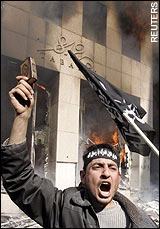 Some report that 20,000 were involved! Moreover, after torching the Danish consulate, they went on satiate their appetite for destruction by torching shops, restaurants and cars in Achrafieh.
What a peace-loving people!
Oh how they respect their neighbors and fellow compatriots!
What a perfect example of "co-existence"
What a wonderful depiction of how backwards our society is!
A Danish artist decides to utilize his modern right of freedom of expression to express what he felt about Muslim terrorism, and Muslims respond like this! The Danes don't need cartoons anymore, all they need to do is to watch their TV sets.
One irony chokes me up more than all the others: The Arab-Muslim world as we know it today is almost completely subsidized by the West.
Arab Muslims are employed by European countries, and then send their remittances home. Arab Muslims also recieve humanitarian and economic aid from Western countries. But most importantly, Arab Muslims (and Persian Muslims) sell oil to the West... oil that is drilled and refined using Western technology and know-how (and, until recently, labor). It is this oil money that then subsidizes the Persian and Arab societies that we live in today.
I don't know if I will ever forgive the West for this addiction of theirs!
Update: The interior minister has submitted his resignation to the cabinet. He claimed that he did what he could to control the protests, but would not order the security services to open fire on Lebanese citizens.
This is good news. Any peaceful resignation of officials that sets an example for the Arab world is a good development. The caveat I have for this particular resignation is that a more competent individual takes his place, and that corresponding political consensus concerning security issues follows.
According to Mr. Saba', there were 1,200 Policemen deployed in Achrafiyeh at the time, and 1,700 army personnel. He also claimed that around a third of those arrested thus far are Lebanese, another third are Syrians and the final third are either Palestinian or claim to belong to Beduin tribes without nationalities.
With regards to the security arrangements taken, I have a couple of words to say: I am no expert on matters of riot control or security affairs, so I may be wrong if I claim that 2,900 security personnel deployed to control a mob of 20,000 seems a bit parsimonious! However, I have seen on TV, and I am sure most of you have too, that the overwhelming majority of those men in uniform are not equiped with riot gear, but rather are thrown in the melee with nothing but M-16 rifles.
Troops carrying rifles sent to riot-control duty are simply useless... unless of course, they are sanctioned to shoot! I've seen this scene over and over again in Lebanon. Security personnel sent to control riots with nothing but their M-16 rifles! Every time I witness those scenes, I get infuriated!
What the hell are these guys gonna do??? Shoot??? If that is what the government wants, then great... put them to use! Don't just send them there to get hurt with rocks and sticks!
So the priority for this next Interior Minister is to get RIOT GEAR... LOTS OF THEM! Forget helicopters, tanks, jets... we need RIOT GEAR! The next time some idiots decide to protest, the POLICE need to be equiped with the right gear to handle the situation... NOT machine-guns!
Saturday, February 04, 2006
Bashar to the world:
If you get rid of me, you will end up with these crazies.

He's really lucky that the "Muslim outrage" really got sparked when a Danish publication published the cartoons. I don't think he would have thought the German or French embassies to be so disposable.
What a way to get a message across, eh?
Major Development...
The IAEA has just reported Iran to the UN Security Council!
Twenty seven of thirty five board members of the IAEA voted to support the resulotion that sent Tehran to the UNSC.
Wanna know who voted against the resolution????
Booboo Bashar - Syria
Crazy Chavez - Venezuela
Senile Castro - Cuba
Need I say more?
Anyways, the ante has just been upped! Cocky Ahmedenijad responded by claiming that Uranium enrichment has been initiated within Iranian territory.
Could he ask the Lebanese Basij to do something if the pressure increases even more?
We will see.
Frankly, if this whole episode ends with the collapse of the "Islamic Republic" I'll celebrate for a week!
Friday, February 03, 2006
How am I supposed to react to this?
Naharnet has quoted Hizballah MP Raad as saying the following:
The resistance will stay on alert as long as our people's security is threatened. Even if Israel withdraws, the resistance is an element of strength in Lebanon's hand. Why then give it up and to whom?
...
The arms of the resistance are not exclusively linked to an Israeli withdrawal from
Shabaa
...
They are part of an equation to protect Lebanon as long as it needs such a protection because neither a truce with the Israelis would reassure the Lebanese, nor would international resolutions shield us
...
The resistance is aware of the Zionist danger to Lebanon and can't relinquish its duty to defend Lebanon if it is attacked by Israel
It is now clearer than ever before: Qais's hypothesis is correct. Hizballah will never relinquish its arms (at least willingly). It seeks to create a Lebanese Basij (if in fact, it has not already done so)... It seeks perpetual war with the state of Israel to justify its armed component, which it ultimately uses to perpetuate itself.
.
 In Iran, the Basij has been used to crush student uprisings and kill desenters. The Iranian Basij is as much an internal security force as it is a protection against external threats. I wonder what makes Lebanese (specifically Lebanese of the Shi'a sect) so sure that Hizballah will not use its own Basij in a similar fashion?
.
I ask myself: what is the use of having someone represent me in parliament if every time I went and complained that he was not doing a good enough job, he would retort that I was blasphemous... or not praying to god enough??? Okay now assume that this man of god has weapons! So if I decide to run against him or to support a competing candidate in the next round of elections, I may end up seeing his dead mother before he does!
.
Ahhhh... religion, politics and weapons! What a refreshing mix!
.
*Picture: A group of enthusiastic members of the Iranian Basij. Look familiar?
Thursday, February 02, 2006
Back From Inertia, The Ministers Return!
The Government is back from its inertia! The Hizbullah and Amal Ministers have declared their return to the Cabinet and by that ending a more than a month-long boycott of the weekly Cabinet meetings.
Time can only tell what was it that made the Shiite Ministers return; what the dialogue was all about and whether they have conceded or got their demands accepted....
But most importantly, they have returned; because Lebanon cannot be run without the Shiite community represented in Government, whatever their political backing is.
"Nobody knows how many rebellions, besides political rebellions, ferment in the masses of life which people earth."
Wednesday, February 01, 2006
Aoun... Sectarian politics vs. Ideals and a Vision for Lebanon
The Sunni political elite’s alliance with the West - notably the US and France has put the Maronite political elite (specifically, General Michel Aoun) in a somewhat awkward position. Traditionally, Maronite politicians were the ones who were closely tied to Western governments, whereas everyone else was stuck with either the USSR or some other “brotherly/sisterly/motherly” Arab country. These strong political bonds between the West and the Maronites were manifestations of broader cultural ones (as well as economic ones) that go as far back as the early 17th century.
Today, the seismic shift of political alliances has made the chess board unrecognizable and provided Lebanon with a unique opportunity. The shift should have created an opening for the Sunni and Maronite political elites to, at the very least, form the most solid political alliance since Lebanon’s independence – one that is based on both parties’ strong relations with Western powers and a shared vision for Lebanon. Unfortunately, that reality has yet to take place. Instead, the top Maronite politician of today, General Michel Aoun, has lead the Maronites into a very unnatural alliance with Syria and the Islamic Republic of Iran.
Aoun’s calculation in refusing to join the March 14 forces was a short-sighted political one, and the support that he has received from the Maronite population is based solely on sectarian competition. He wanted to enter Lebanon the way Yasser Arafat entered Palestine. He saw himself as the true representative of the Maronites, and completely disregarded those politicians who stayed behind. His self-righteousness and short-sighted vindictiveness has, among other things, helped to destroy March 14 and has turned the Maronite population into supporters of Tehran’s agenda in Lebanon!
The justifications one would find in Lebanon for Aoun’s behavior on the Lebanese Maronite street are the following:
- He is actually “neutral”
- He is protecting the Maronite population while the Muslims duke it out amongst themselves
- He is teaching both Jumblatt and Nasrallah a lesson because they formed their Baabda-Aley electoral alliance and left him out in the cold
- Finally, there is old Dr. Victorino’s line, that the Hariri’s are nothing more than Wahhabists in disguise – and that if the Maronites had to choose between Wahhabists and Khomeinists, they prefer the latter.
It is so disheartening to witness how sectarianism manifests itself in politics… Whereas this conflict could easily have been framed as a conflict between Culture, Ideals and Visions, it is now framed in purely sectarian terms. If the March 14 alliance had included Aoun, Hizballah would have been isolated and had no choice but to face all of Lebanon. Given those circumstances, this current crisis we now face would have ended a long time ago.
Of course, the cement – or glue – that would bring all of the March 14 forces together (with Aoun) would not have been sectarian – there is no sectarian reason why Druze Sunnis, and Maronites should converge against Shi’as. Rather, the glue of the coalition would have been:
- a shared vision for Lebanon and Lebanon’s future – one that is modern and economically prosperous as well as one that is not in a perpetual state of war with Israel (fighting for Tehran’s and Damascus’s interests)
- a shared belief that modern civilization along with an open society and liberal economy is the path that Lebanon will take in the future – rather than a religiously conservative one that suggests visions that compete with modernity and secularism.
Of course, rather than take this path, Aoun has decided that political calculations are the more pertinent ones. Just look at the way he handled MP Naim’s death! Ultimately by doing so, Aoun may have gained more political stature – and consequently given the Maronite community the loudest voice they have ever had since the late 1980s. But at what price???
Where will this take Lebanon as a country??? Where will Aoun’s politicking lead us?
I believe that the Maronite population will eventually regret Aoun’s entry into Lebanese politics. For the first time in Lebanon’s history, the Sunni and Druze political elites screamed “Lebanon First” with the backing of the West, and the Maronite elite quietly swam in the other direction! What a shame! This lost opportunity will be recorded in our long, sad and bloody history.
Monday, January 30, 2006
Two Instances, Worlds Apart!

Yesterday I was struck by a great example which depicts the dichotomy in our Arab society.
I was watching "Super Star", the Arab version of the American Idol show, where three contestants were competing for the Super Star title: one Syrian, one Tunisian, and one Saudi. There were two women from the audience, looking glamorous and young, carrying the Saudi green flag, showing support for the Saudi contestant.
This picture struck me, because just a couple of days back, Hamas won the parliamentary elections in the Palestinian territories, and they too carry the green, Saudi flag, which contains the shahadatan inscription on it and symbolizes the Islamic umma. This flag is also used by the Jama'a Islamiyya of Lebanon as their emblem.
In one instance, the flag was used to support the Arts in the Arab world, a cultural aspect which is viewed as disgraceful and blasphemous in some Islamic fundamentalist circles; not only that, a cultural aspect that has become in the Arab world extremely vulgar and commercial as well.
In the other instance, the same flag is used to stand for politics in the Arab world, which carry notions that nowadays have become increasingly extreme, fundamentalist, and violent. Think resistance, jihad, religious puritanism, death cults....and mob rule.
But this is our Arab world for you, symbolized and nicely summarized in these two instances...and pictures speak more than one thousand words....
"Nobody knows how many rebellions, besides political rebellions, ferment in the masses of life which people earth."
Saturday, January 28, 2006
The dirty secret of sectarianism in Lebanon
I came back from Lebanon with a new belief engrained in my head. That belief is that changing Lebanese living in Lebanon is an impossible task. The people living in Lebanon will basically remain sectarian until Kingdom come.
.
Let me put it this way: if I was a "reformer" going to Lebanon to attempt to resolve this issue of sectarianism, and I had to list all the barriers I saw in my path, I would list the following:
- Lebanese are financially encouraged to remain sectarian
- Lebanese are emotionally bribed to remain sectarian
- Lebanese are spiritually cajoled to remain sectarian
Financial, emotional and spiritual reasons to maintain the status quo. Of course, juxtapose these incentives with the excommunication that one would experience if he or she decided to take the unthinkable path of (for example) marrying an individual from another sect.
.
Now you tell me how it is possible for any one in Lebanon NOT to be sectarian!
.
The notion of a third path is nonexistent. The third path, of course, is your own - your individual path. That route, in Manichean Lebanon, where you are either "with us or with them," is simply laughable. In our wonderful Lebanon, you are either an "insider" or an "outsider," there is no other way.
.
What is discussed at home is, at the best of circumstances, a mix of rational discourse with irrational sectarian jumble. The irrational jumble is the most prominent portion of the discussion in almost every occasion. It is during these grueling sessions where you begin to realize that political disagreements and conflicts are used to reinforce the long-established sectarian divisions within society - not the other way around. In other words, sectarianism would not go away if, somehow, Jumblatt, Aoun, Future, Hizballah, Amal, LF and the rest were best of buddies!
.
Generalizations about the "characteristics" of Mwarni, Shi'a, Druze and Sunna are thrown out there to reinforce sectarian bonds and fissures. Usually, nothing else unites the people in the room except familial and sectarian ties, so they are most comfortable when nonsense about other sects starts spewing out of someone's mouth. If you interject and try to infuse some sanity into the discourse, you will be ostracized, because you threaten the cohesion within the group and the cordial atmosphere that this insane sectarian discourse is fostering (ironic, isn't it?).
.
In summation, I have come back to the United States with a staggering weight on my chest. Even my desire to blog has diminished somewhat because I have come to realize the futility of this exercise. My innate desire has always been to somehow try to foment change for the better in Lebanon. Now, I believe that I need to reconcile myself with something a close relative of mine has told me over and over again:
If you want people to acknowledge that they cannot change you, your own thoughts and the choices that you have made in your life, then you must accept that you cannot change them, their own thoughts, or the choices that they have made in their own lives.
Well... there goes Lebanon!
Thursday, January 26, 2006
Hariri And My Question
Raja is back to the business-as-usual mode, which really means that I'm not going to be the only one "managing" our dear blog. Welcome back Raja!
On another point, Raja mentioned that we attended the presentation MP Saad Hariri conducted at the Woodrow Wilson Research Center in DC yesterday. I was bold enough to ask Hariri a question, during the hour-long question-and-answer session. You can find my question referenced in Al-Mustaqbal on page 4:
Among the attendants was journalist Naseer As'ad, who alternates the writing of Al-Mustaqbal's editorials with Fares Kashan and who is a favorite analyst, MP Bassem Sabeh, MP Farid Makari, and former MP Ghattas Khoury.
When Saad Hariri entered the conference room, my eyes got fixated on him. His features are strong, he's tall, has a wide chest and shoulders, and he looked serious. His soft eyes contrasted the boldness of the dark hair and the beard.
When he spoke, however, that impression changed. He is soft-spoken, in contrast to his features. Some of what he said was overshadowed by my thoughts of asking a question to him. I hesitated by raising my hand to request the microphone, but I did, and he was funny and nice when he answered my question.
What struck me though, was when journalist Hisham Melhem asked him a tough question about how Hariri would face the vision he has of Lebanon with that of Hizbullah's, which is diametrically opposed to his. Hariri said that he liked the question, because it is a tough one. His answer, unfortunately, was vague; he believed that the Lebanese need to be given enough time to resolve all their standing issues amongst themselves. So basically he thinks that time will be the solution. I wanted to grab the microphone and say: but as we wait longer to resolve those contentious issues, regional pressures are increasing and affecting the country's stability...but of course I didn't.
Despite his lack of political savvy, his sincerity and belief in Lebanon were very powerful. By virtue of answering my question, saying that accusations of internationalizing Lebanese affairs will be ignored, as he stands strongly by his convictions...shows his strength of heart and determination.
This answer reminded me of the late Rafiq Hariri; his strength lied in his determination and perseverance to resolve difficult problems and his love of Lebanon...all shrouded in a soft-spoken, calm, and quiet aura. The late Rafiq Hariri was not politically savvy, but he always surrounded himself by experts and always listened and was willing to learn. I believe his son is following in his footsteps. I wish him luck. In the hopes that the idealism he carries will not be tarnished by years in politics, especially the Lebanese type.
"Nobody knows how many rebellions, besides political rebellions, ferment in the masses of life which people earth."
On another point, Raja mentioned that we attended the presentation MP Saad Hariri conducted at the Woodrow Wilson Research Center in DC yesterday. I was bold enough to ask Hariri a question, during the hour-long question-and-answer session. You can find my question referenced in Al-Mustaqbal on page 4:
بعد لقائك الرئيس بوش كيف سترد على من يتهمك بتدويل القضية اللبنانية؟ـ لن اعير هذا
الامر أي اهتمام وأنا اؤمن بأنني اعمل لصالح لبنان ومصالحه، ولا اكترث لرأي أي كان
في انتماءاتي فانا انتمي الى لبنان الحر.
Among the attendants was journalist Naseer As'ad, who alternates the writing of Al-Mustaqbal's editorials with Fares Kashan and who is a favorite analyst, MP Bassem Sabeh, MP Farid Makari, and former MP Ghattas Khoury.
When Saad Hariri entered the conference room, my eyes got fixated on him. His features are strong, he's tall, has a wide chest and shoulders, and he looked serious. His soft eyes contrasted the boldness of the dark hair and the beard.
When he spoke, however, that impression changed. He is soft-spoken, in contrast to his features. Some of what he said was overshadowed by my thoughts of asking a question to him. I hesitated by raising my hand to request the microphone, but I did, and he was funny and nice when he answered my question.
What struck me though, was when journalist Hisham Melhem asked him a tough question about how Hariri would face the vision he has of Lebanon with that of Hizbullah's, which is diametrically opposed to his. Hariri said that he liked the question, because it is a tough one. His answer, unfortunately, was vague; he believed that the Lebanese need to be given enough time to resolve all their standing issues amongst themselves. So basically he thinks that time will be the solution. I wanted to grab the microphone and say: but as we wait longer to resolve those contentious issues, regional pressures are increasing and affecting the country's stability...but of course I didn't.
Despite his lack of political savvy, his sincerity and belief in Lebanon were very powerful. By virtue of answering my question, saying that accusations of internationalizing Lebanese affairs will be ignored, as he stands strongly by his convictions...shows his strength of heart and determination.
This answer reminded me of the late Rafiq Hariri; his strength lied in his determination and perseverance to resolve difficult problems and his love of Lebanon...all shrouded in a soft-spoken, calm, and quiet aura. The late Rafiq Hariri was not politically savvy, but he always surrounded himself by experts and always listened and was willing to learn. I believe his son is following in his footsteps. I wish him luck. In the hopes that the idealism he carries will not be tarnished by years in politics, especially the Lebanese type.
"Nobody knows how many rebellions, besides political rebellions, ferment in the masses of life which people earth."
Wednesday, January 25, 2006
back in the States! Sa'ad's performance and bad news from home...
I'm back in the States. Home? In certain ways, yes. In other ways, home is thousands of miles away.
With regards to my trip to Lebanon, I don't believe that I have the words to express the feelings I experienced. Maybe they will come with time. Thus far though, I have two words: profound and volatile.
As for today, my second day in the States, I have already experienced a significant event: Sa'ad al Hariri's speech at the Woodrow Wilson Center in Washington DC.
Doha and Firas also attended. Unfortunately, we really did not have time to flesh out our thoughts about Sa'ad's performance since both of them needed to return to their jobs in a hurry. Therefore, I will post my thoughts on this entry, and hope that both of them reciprocate with their own thoughts on the event.
My thoughts on the speech:
Saad is a poor speaker: he lacks the political vocabulary - in both English and Arabic. The man needs to invest the time and money needed to improve his communications skills. He is yet to master some basic concepts and terms in the political lexicon of both languages. His father was a poor English speaker, but at least he was comfortable with Arabic.
The guy is definitely sincere: There's no doubt about it. As Firas said in our brief discussion, the man talks too much from his heart, and too little from his mind.
He didn't really answer questions: Considering that he is a politician, I wonder whether that is a bad or a good trait!
Hariri seemed upbeat: He claimed that the political deadlock Lebanon is currently experiencing would end in a couple of weeks. This prediction is based on his assumption that all political parties have Lebanon as their number one priority (a very weak assumption indeed).
On that note, I will end my observations, and interject with some news that I bring with me from Lebanon. We should all watch out for developments in the Shi'a ceremonies of Ashoura. Focus your telescopes on the town of Shoueifat, a formerly Druze town that now hosts a diverse population of Shi'a and Druze (approximately 50-50). Security personnel that I have talked to are worried that violence may erupt on that day – assuming that either side wishes to escalate, what better opportunity. Moreover, even if both sides do not desire escalation, tensions are so high that a third party may do the trick and instigate bloodshed.
Hopefully, nothing will come of these fears. But rumors like these, and others around the country, just go to show how tense the situation in Lebanon is today. It ain’t pretty!
Sunday, January 22, 2006
Traces Of Memories

A Swiss friend of mine, Mathias, is working on 'TRACES OF MEMORIES' about Lebanon, as an elective diploma project and it is very much worth checking out. It would also be great to hear your comments on the work he’s done so far. I’m starting with this: a photo he took in Gemayze. It’s right under the balcony of a good friend of mine, and an FPM office, which I pass by every day on my way to work. The thing about it for me? The first time I went to Gemayze itself was in 2000, when I met this friend.
Where Are The Damascene Women?
I recently reread a dissertation written by Dr. Michael Provence entitled Plowshares into Swords: anti-colonial resistance and popular nationalism in French mandate Syria, 1925-1926. Dr. Provence begins Chapter IV of the book with a very interesting quote - one that points to the political vitality of Damascenes prior to the Ba'th-takeover, and one that I hope is a forcast of things to come.
Allow me to contextualize:
It is the year 1925. A popular rebellion against the French madate has just begun in the Syrian countryside. The Druze, with Beduin help, have just vanquished a French expeditionary force sent to occupy the town of Soueida'.
The Quote:
I am looking forward to reading similar pamphlets coming from Damascus.
Allow me to contextualize:
It is the year 1925. A popular rebellion against the French madate has just begun in the Syrian countryside. The Druze, with Beduin help, have just vanquished a French expeditionary force sent to occupy the town of Soueida'.
The Quote:
Appeal for the Women's Society to Damascus
O Arabs, descendants of glorious ancestors, we appeal to you to awake in these critical times of great tragedy under the government of France. There is nothing left to us but to mount a vigorous attack and expel this government from our country.
O People, this is an auspicious moment, we must not let it pass, To Arms! To Arms! The time has come to realize what you have promised to yourselves.
O People, your brothers of the countryside have made an appeal to your courage. Unleash your arms before the enemy who has invaded our homes, set fire to our temples of God, and tread on our sacred books...
This quote highlights the level of grassroots political activity that appeared to manifest itself in Damascus as far back as the 1920s (just in case, you all should have taken notice that it was a woman's society that released this pamphlet). I hope it reminds this blog's Syrian readers that there really was a time prior to the Ba'th hegemony during which politics was the peoples' business, and not necessarily the business of a specific family and its violent thugs.
I am looking forward to reading similar pamphlets coming from Damascus.
Saturday, January 21, 2006
Assad's Latest Speech: Nothing Has Changed!
Bashar now says that the call to demarcate the Lebanese-Syrian borders around the Shebaa Farms is an Israeli demand! He compared the Shebaa Farms' size to the complex he is delivering the speech from, to basically ridicule its tiny size.
He also said that present in the Arab lawyers' conference in Damascus are Lebanese lawyers, who came from the alleys (zwereeb) of Lebanon onto the Arab Highway leading to Damascus!
Please, silence this man!
More to come on his latest speech...
The March 14 bloc has responded by saying that despite how tiny the Shebaa Farms are, they detemine Lebanon's destiny. Moreover, the bloc said that those parties condemning the internationalization of Lebanese affairs, have also taken part in such internationalization by visiting Damascus yesterday, meeting with Iran's President Ahmadinejad, and bearing witness to the Iran-Syria consolidation of regional policies.
More strikingly, the bloc declared Berri's visit to Damascus as that which has undermined his position as a House Speaker who has initiated national dialogue as a national leader, to that of solely the leader of the Amal Movement. I agree with that point.
"Nobody knows how many rebellions, besides political rebellions, ferment in the masses of life which people earth."
Friday, January 20, 2006
Beyk And Sayyid: Jumblatt On Future TV
Just heard Jumblatt's interview on Future TV; a venue through which, as the reporter said, Jumblat was able to respond point-by-point to Sayyid Hassan Nasrallah's New TV interview which touched on Jumblatt's latest statements and the March 14 bloc.
I am not going to recount the interview but I must state the following striking points made by Jumblatt:
One, Jumblatt said that the point of contention between him and Sayyid Nasrallah is basically on their position towards the Syrian regime.
Second, when asked whether Jumblatt would be willing to meet with Sayyid Nasrallah, he replied that any talks or discussions should take place through the Cabinet; that's the priority now.
Third, when asked to respond to Sayyid Nasrallah's point that he gave up his son for Lebanon, what more should they do to prove that they're Lebanese, Jumblatt said that he wished if his father Kamal Jumblatt was killed by the Israelis; unfortunately, he was killed by the Syrian regime. He added that he appreciates Hizbullah's sacrifices, but that many parties and groups in Lebanon have given martyrs as well. He also added that his belief is that Hafez Assad's reign was far from being humane; however, he was forced to concede to the Syrian forces upon his father's assassination in order to protect his people during a difficult time in Lebanon's history.
Fourth, he asserts Lebanon's right to decide what is good for itself; so he thanks Arab efforts for helping us, yet at the end of the day, we should be able to make the final decision.
Last but not least, he said that if Ahmadinejad and Bashar Assad both agreed back in Damascus that they endorse resistance, then why isn't Ahmadinejad sending his army to the Golan Heights, and why isn't Assad opening up the Golan front for resistance fighting?...
Of course, the two-hour long interview contained more pertinent issues fleshed out and explained by Jumblatt, which will most probably be in Saturday's press.
On another point, House Speaker Berri and Sayyid Nasrallah visited Damascus today to meet up with Iran's President Ahmadinejad. Just an FYI!
"Nobody knows how many rebellions, besides political rebellions, ferment in the masses of life which people earth."
Aoun: Vague Stands For A Presidential Aspirant
Do we all recall when Aoun said back in the summer of 2005 that he agrees with the Future Movement on 90% of issues? Yesterday he said to a delegation from the National Council for Information that he considers the closest ally to him in Lebanon is Hizbullah, especially in the matters of reform, mass graves and internal issues, that they hold similar views on reform and corruption.
I am confused by Aoun's stands. It seems that he holds similar views to many parties in Lebanon, yet not.
What about the recent talk of closing ranks with the March 14 forces, especially the "cozying" relations between Aoun's parliamentary bloc and Jumblatt?
It's clear that Aoun is playing the balancing role of being "in the middle"; the role of a Presidential aspirant.
Nevertheless, I must concede that his statement yesterday that any entity disarming needs the Lebanese to be empathetic towards it as it transforms itself into a solely political force, of course implying Hizbullah, was a statement of a President's caliber...but despite that, vagueness has shrouded Aoun's stands since his arrival to Lebanon from exile in Paris. We are most of the time left unclear about what his views are towards the government, the March 14 bloc, Hizbullah, Syria, and many other issues...if he wants a true popular backing for President, Aoun must seize to remind us in his rhetoric of the vague statements coming from Baabda.
"Nobody knows how many rebellions, besides political rebellions, ferment in the masses of life which people earth."
Thursday, January 19, 2006
Istiqrar wa Istiqlal: Different And Not The Same
I so much want to write this post in Arabic, but I'll do with what I can through this venue in English.
There is a great difference between stability (istiqrar) and independence (istiqlal). There is a great difference.
Yesterday, after meeting with Iran's President Ahmadinejad, Syrian President Assad said the following: "We have reasserted our support for stability in Lebanon, the importance of backing the resistance and preventing any intervention in Lebanon's internal affairs and in internationalizing these affairs."
President Assad continues, "We have agreed to support the Palestinian people and to endorse the formation of an independent Palestinian state."
The Syrian President very clearly still does not endorse an independent, sovereign Lebanon. He makes sure not to say these terms on record. However, it seems not difficult for him to endorse the independence for the Palestinian state; which I personally endorse...along with my country's independence.
But what does stability mean for Lebanon? Stability can mean not moving forward, not witnessing change. Change and progress have always brought with them turmoil; and people throughout modern history have come up with mechanisms to mitigate for the negative effects of change and to highlight the positive aspects of progress. I view instability at times in Lebanon as a healthy sign of us moving forward, of us progressing; unlike the past 15 years which I recall vividly, where I was told to be glad that Lebanon is being rebuilt, but that being afraid of instigating change should be a given.
I was raised to be afraid of a mythical character, a character I have not seen, but one which overhears, spies, bribes, tortures, and kills.
And what does President Assad mean when he declares that he has agreed with Ahmadinejad that any intervention in Lebanon's internal affairs should be prevented, including the internationalization (tadweel) of these affairs? Who will he prevent from intervening? And how will he prevent any internationalization of our affairs? I would have liked if President Assad educated his audience of the tools he will resort to in order to accomplish his foreign policies.
Of how much I thought that Ahmadinejad's statements would be more inflammatory than Assad's, I was disappointed to find the opposite was true.
Ahmadinejad, in fact, had a better statement to declare: "We are of the conviction that the Lebanese peoples are dear, generous, are able to solve the problems facing them on their own, and are able to rely on themselves."
I can say to that, yes, I believe so, Mr. Ahmadinejad. I believe that we can, and we will try our best, to rely on ourselves and face and solve our problems on our own, if we are given the chance to.
In the face of inevitable western and eastern internationalization of Lebanon, in the face of so many countries caring for our stability and independence at once, I stand helpless. Can our Parliament reconvene? Perhaps it was the days when free Parliamentarians raised their voices from the Parliament's podium into the viewers' and listeners' hearts, on the eve of March 14 of 2005, that I felt Lebanon was truely free and independent.
"Nobody knows how many rebellions, besides political rebellions, ferment in the masses of life which people earth."
Tuesday, January 17, 2006
Street Response To Strategic Destiny
I guess I did not have to wait until Friday, when Iranian President Ahmadinejad visits Syria, to know Hizbullah/Amal's stand and response to many of our questions on Lebanon's "strategic" destiny.
I just watched the news right now: thousands of Lebanese youth chanting after former MP Khatib on the gates of the U.S. embassy in Awkar, "Hail to Ahmadinejad!", "Iran, Iran, Iran!" and "Hail to Bashar Assad!".
"Nobody knows how many rebellions, besides political rebellions, ferment in the masses of life which people earth."
Honor And Arms!
Short of sending thousands to the U.S. embassy in Awkar to protest American "tutelage" over Lebanon today, while hailing Hamas and the insurgency in Iraq, Hizbullah's Sayyid Hassan Nasrallah declared that "the arms of the resistance (silah al-mouqawama) is the sanctity of all sancitities. It is like honor ('ard) and we are oriental. I cannot stand anyone meddling with my honor and the resistance arms are our honor!"
Note that it is not the resistance that is sanctified, which to me is a noble endeavour, though I believe in peaceful resistance, but Sayyid Nasrallah is declaring the arms of the resistance to be sanctified...which entirely shifts and rearranges, at least to my understanding, all that has been negotiated on...or perhaps I've been blind and deaf all along.
This means that Hizbullah can never be disarmed if it does not deem it time to do so or else it would put up a fight (which refutes what Hassan is claiming in his comments on my previous post that Hizbullah's arms will never be used internally). This means that all this talk about internal dialogue to disarm Hizbullah was a waste of time. How did Hizbullah agree to the Cabinet policy statement which stated that Hizbullah's disarmament is an internal issue to be resolved through dialogue? Were they lying to others? And why now are they choosing to delete any mention of disarmament in the Cabinet's policy statement? Do not tell me it is because of Jumblatt! This would be a petty excuse!
I demand to know the truth; I demand transparency!
"Nobody knows how many rebellions, besides political rebellions, ferment in the masses of life which people earth."
Monday, January 16, 2006
When Will They Respond?
So...when will the Hizbullah/Amal Ministers return to the Cabinet? Is it after Iran's President Ahmadinejad visits Syria this coming Friday, January 20th? Is it after Ahmadinejad cements his country's strategic, military/defense pact with Syria, and by that putting all rumors at bay of an Iran-Syria axis?
When will Hizbullah and the Amal Movement return to the Cabinet? Return to the Lebanese umbrella? Or will they never after that historical meeting in four days?
After Jumblatt's 180-degrees move away from a stand he once took back then to bring all Lebanese "power-parties" together, namely extending a hand to the March 8 group, Hizbullah and Amal, and lobbying along with the Future Movement for the "sanctity" of the resistance (which burned his bridges with many in the Christian street), Hizbullah did not utter a word. No response: not in a speech, nor on the negotiating table.
And then in less than a day apart, Hizbullah and Amal respond: they respond by sending their youth on the streets to protest U.S. envoy, David Welch's visit, not absent of casualties, and then they take from all what Jumblatt has been saying for weeks on now a small, tiny sliver and attack, according to Naseer Ass'ad, the symbol of the "reconciliatory" move to bridge the gap between March 14 and March 8. That tiny "sliver" was when Jumblatt accused that some in Lebanon carry "weapons of betrayal" (silah al-ghadr); Hizbullah took it to be their weapons that Jumblatt was describing, while what he was describing was Ahmad Jibreel's Popular Front of the Liberation of Palestine.
Yet, the Lebanese are still waiting for a response from Hizbullah and Amal: when are they going to return to Lebanon's Cabinet? When are they going to let the Lebanese know of their stand towards many of the questions that occupy our minds about the fate of our country?
If it is true and we do not hear from them until after Ahmadinejad's visit to Syria, then it would be disheartening to learn that Hizbullah has declared itself indeed an appendage of the Iran-Syria axis, to the detriment of Lebanon's sovereignty, to the detriment of Lebanon's unity, to the detriment of ever dreaming that Lebanon can be at peace with itself.
"Nobody knows how many rebellions, besides political rebellions, ferment in the masses of life which people earth."
Thursday, January 05, 2006
Hope springs eternal
I thought I should share this. William Saroyan's words on the Armenian people are a must-read whenever I'm feeling down:
“I should like to see any power in this world destroy this race, this small tribe of unimportant people whose wars have been fought and lost, whose structures have crumbled, whose literature is unread, whose music is unheard and whose prayers are no more answered. Go ahead, destroy this race! Destroy Armenia! See if you can do it. Send them away from their homes into the desert. Let them have neither bread or water. Burn their homes and churches. Then, see if they will not live again, see if they will not sing and pray again. For when two of them meet anywhere in the world, see if they will not create a New Armenia.”
Somewhere in me, I can say the same of Lebanon.
connecting the dots!
I have been accused by some readers of being too narrow in my analysis and interpretation of recent events. Last week, when Khaddam was interviewed by al Arabiyya, I published an entry that essentially claimed that Khaddam's interview was a card in the Hariri family's war against the Assads. Numerous anonymous writers criticized me for limiting my analysis of Khaddam's interview to the Hariri-justice-Lebanon prism, rather than taking a broader view that included the US, Saudi Arabia and their designs over Syria.
.
Today, I plan to challenge that misperception by connecting what I see as the regional dots together. I hope to convey to you the idea that developments that occur in Iraq, Afghanistan, Iran, Lebanon and Syria are not just isolated and localized, but rather parts of a comprehensive regional competition for dominance over the region.
.
First, we have Iran. A couple of days ago, the Caveman Linguist published a post that highlighted continued efforts by certain elements in the Iranian province of Baluchistan to challenge the regime's control of the province and consequently foment instability. Baluchistan is an overwhelmingly Sunni province, and one in which Ahmedenijad's convoy was attacked only around a month ago. Caveman suspects that the Americans, Saudis, and/or Pakistanis may have played a role in these efforts to destabilize Iran in response to Iran's own destabilization campaign of Iraq as well as its regional ambitions.
.
Second, over the past two days, over 183 people (at least seven of whom were American soldiers and marines) have died in Iraq as a result of a sudden resurgence in terrorist violence. The level of bloodshed is the highest since elections took place in that country. This escalation has occured immediately after Khaddam's interview, and the consequent UN investigating committee's formal request to interview Bashar el Assad. Could these events be the product of the official Syro-Iranian agreement to "protect each other from all 'foreign threats,'" which was signed merely a couple of months ago?
.
Third, and as if on cue, Iranian delegates left Vienna without showing up to an IAEA meeting that they were scheduled to attend. In the meeting, they were supposed to explain why they feel it is necessary for them to enrich their own uranium - or, in other words, justify to the international community certain aspects of their nuclear program. Apparently, they have come to the last-minute-conclusion that they do not need to justify anything concerning their nuclear program to anyone. They have also announced that they will begin to test machinery that can be used to make weapons-grade uranium in a "move that appears to scupper prospects of a settlement of its long-running nuclear dispute with the west."
.
And finally, ten Afghanis were killed and at least fifty wounded as a result of a suicide-bomb attack in a province that the American ambassador was visiting that same day.
.
Put together, these events may give a panoramic view of the tit-for-tat that is currently taking place between the regional and international powers that play the Middle Eastern game today. Assuming I am correct in connecting these dots, one fact stands out above all others: the common weapon that all of the belligerent parties share is instability – instability in Afghanistan, Iraq, Lebanon and even Iran. Another fact stands out: the recent spurt of violence in Iraq brings into question the popular belief that Zarqawi is the chief mover of terrorist violence in that country – unless he is in cahoots with the Iranians and Syrians.
.
Whatever the case, it is clear to me that the recent upsurge of violence in Iraq, coming on the tail of Khaddam’s interview and the increased international pressure on Syria, simply cannot be mere coincidence! Moreover, the sudden, "inexplicable" departure of the Iranians from Vienna is actually all too explicable. These two countries are flexing their muscles and showing the world that they can stir up a considerable amount of trouble. As for the disturbances in Iran, check out the Caveman's analysis. There is a liklihood that Iran's adversaries are giving it a taste of its own medicine.
On Khaddam And Regime Change
"Diq il-hadeed w huwwe hamee"
Jumblatt has openly called for regime change in Syria...now that former Syrian Vice-President Khaddam has provided the whole world with an alternative to the either-the-Assad-rule-or-the-Muslim-Brotherhood equation.
As I read through the entire interview that Al-Arabiyya conducted with Khaddam, it was clear his intentions. His breaking away from the Syrian Baath party and his public confession of the internal dynamics within the Bashar Assad circle of the past five years are not a "cathartic" move, taken by someone who wishes to live in peace and quiet for the remaining years of his life. No! Khaddam's words (which by the way, he did not wish to be interrupted by the interviewer) had a message, they carried weight, they were ideological and strategic, they in short laid down domestic and foreign policies and strategies that Syria needs to take in order to move forward in these changing times.
Khaddam said that he had a choice, between the regime and the nation; he claims that he chose the nation. And for the nation to move forward, he believes that Syria should foster openness, not necessarily towards the outside world, no, but towards its people. He explained that at those critical times in Syria's history, what the leadership should do is to take a step towards national reconciliation (doesn't this term remind you of Lebanese political jargon? Syria needs some of it); instead of alienating Syrian citizens more and more from their country, through exile and persecution, which would inevitably lead to regime overthrow and chaos, it's advisable to bring everyone together under the banner of the nation (watan).
He further talks about a re-definition of an Arab umma, a re-definition of nationalism....
You know? These words might be coming from a corrupt person (as many Syrians and Lebanese claim), but they are not entirely worthless.
But a decision for change can only come from the Syrian people themselves. I wish the Syrian people the best of luck and the Lebanese people (my people) the best of luck and peace.
"Nobody knows how many rebellions, besides political rebellions, ferment in the masses of life which people earth."
Wednesday, January 04, 2006
Beirut: The stories beyond the headlines
The Stories Behind the Headlines is an entry that summarizes what I have learnt thus far into my stay in Lebanon. There are four blurbs titled
- Beirut Needs to Calm Down
- The Lebanese Ministry of Public Works and Transportation Needs a New Minister
- AUB Needs Qualified Business Instructors and Professors
- Lebanon is Running Out of Engineers
As I stay longer in Lebanon, I will learn more and update this blog accordingly.
Beirut Needs to Calm Down
Today, at around 1:00 PM my brother called me and asked that I turn on the television. He said that he had heard rumors that a bomb went off somewhere in the country, and that he needed me to confirm whether or not it actually happened. As you all know from internet news sources, nothing really happened.
This little incident is evidence of the tension that most residents of this city and country are living under. Everybody seems to be going about doing their own thing, seemingly oblivious to political developments. Scratch the surface only a little, and it turns out that this indifference is only skin deep. Edginess is to be expected of course, but the experience with my brother was still hair-raising.
The Lebanese Ministry of Public Works and Transportation Needs a New Minister
My uncle is an American-educated traffic engineer. He is one of the only members of that profession in Lebanon, and has been working as a consultant for the Ministry of Public Works and Transportation for the past ten years.
Apparently, the worst minister he has ever advised is the current one, Mohammed Safadi. Mr. Safadi has no agenda (official or unofficial) for the post he was appointed to. He is simply using public office as a PR stint to further his personal goals, and to illegally asphalt roads he personally deems need to be asphalted.
AUB Needs Qualified Business Instructors and Professors
Rumor is rife: the AUB student body, specifically the segment that attends the business school, claims that around 60 percent of the faculty employed by that school (officially known as the Olayan Business School) is unqualified. Specific anecdotes from my sister’s experience support these rumors.
One of my sister’s lecturer asks her students to come to class 10 to 15 minutes late because that is when she usually shows up. She then leaves 45 minutes later despite the fact that the class is supposed to last for another half an hour. Her excuse is that she just delivered a baby.
Another one of my sister’s lecturers was just fired because the students petitioned to the administration and claimed that he was a miserable teacher. Only those of you who actually attended AUB will realize the audacity of business students petitioning to replace an ineffective teacher. A demanding one, maybe. But an ineffective one?!?!.
A sample of his behavior includes the following: 1) not returning any assignments graded, 2) postponing the midterm three times because he either didn’t show up on the day of the test (funny, I thought it was the students who didn’t show up to tests), and 3) having an overall attendance rate that even students would be ashamed of.
The ridiculousness of this situation can only be appreciated if you keep in mind this is happening in a business school, where if anything, punctuality and deadlines are emphasized more than quality of work. Follow that up with the fact that the Olayan Foundation donated tens of millions of dollars only a few months ago to improve the school, and then you start to wonder what the hell is going on.
I am going to do AUB a favor right now: If you have a master’s degree in business administration, finance or marketing, and are punctual and can communicate effectively to peers as well as subordinates, apply to the Olayan Business School. God knows, they need you and they definitely have the money to pay you!
Lebanon is Running Out of Engineers
The Gulf region has returned to its heydays. This year alone, it is investing $250 billion dollars in physical infrastructure. The consequence: Lebanon is running out of engineers, and AUB engineering graduates do not have to work for $400 dollars a month as site managers in Beirut. Urban myths are all over the placet. One such myth (I actually wouldn’t be surprised if it were true) is that a Lebanese architect who works in Switzerland went to Qatar to visit family. While in the hotel he met a Qatari man. He is now designing two residential towers for that individual.
Let me therefore recommend that if you have family in Qatar, or any where in the Gulf, give them a call, tell them you are going over for a visit (it doesn’t matter how distant these relatives are), insist on staying in a hotel, and mingle with as many khaleejis as possible. Who knows? You might hit the jackpot!
Tuesday, January 03, 2006
Ghassan Tueni Runs For Slain Son's Parliamant Seat
Ghassan Tueni, the father, has heeded the call and has agreed to run for his slain son's seat in Parliament.
"Nobody knows how many rebellions, besides political rebellions, ferment in the masses of life which people earth."
"Nobody knows how many rebellions, besides political rebellions, ferment in the masses of life which people earth."
Stop Being Agents Of The Killers!
Let's track the talk:
In a meeting with Talal Arslan, an SSNP official, Toufic Mhanna, said that in breaking up with the Syrian Baath regime, Khaddam has "assassinated himself."
Is this a death warrant?...
Arslan and his SSNP friends previously have sent death warrants to the late Rafiq Hariri prior to his assassination, and Khaddam further solidified this allegation in his interview to Al-Arabiyya on the 30th of December.
Mr. Arslan et al.: we're tracking your words; so stop being agents of the killers!
"Nobody knows how many rebellions, besides political rebellions, ferment in the masses of life which people earth."
On my way to Lebanon
I have debated whether or not to announce my return to Lebanon on this blog for quite some time now - just like how I debated whether or not to announce it the last time around. This fear, coming from an obscure blogger who speaks his mind (in English, mind you) without hiding his identity, goes a long way to highlight the atmosphere of fear that we as Lebanese grew up in, under the tutelage of a dictatorial regime, and in a society where the courts of law are not exactly the most effective deterrents against violence (be it physical or emotional). Despite this fear, I am typing this entry, because ultimately it is an irrational one that I need to overcome.
.
The possibility of a major "incident" taking place while I am in Beirut is a very real one that I simply cannot remove from my mind. Unlike the last time I visited, I am overwhelmed by concern and fear. In my previous visit, my priorities were to spend quality time with family and friends, as well as visit personal landmarks such as my old high school, ACS and the venerable AUB.
.
Now I return with a huge cloud over my head. I return with a desire to be closer to developments, and to even take part in them. Every other desire I used to have on the top of my priority list now seems pedestrian. My mind is clouded yet simultaneously focused.
.
Somehow, I am also preparing myself for disappointment. Every time I return to Lebanon, rather than feel closer to developments, I feel more distant. It is a weird feeling that I attribute to the powerlessness Lebanese feel about the direction of their own destiny. I usually find myself answering more questions than asking. People assume that I bring with me the secrets and intentions of Washington - and consequently, a peak into their own future.
.
.
The possibility of a major "incident" taking place while I am in Beirut is a very real one that I simply cannot remove from my mind. Unlike the last time I visited, I am overwhelmed by concern and fear. In my previous visit, my priorities were to spend quality time with family and friends, as well as visit personal landmarks such as my old high school, ACS and the venerable AUB.
.
Now I return with a huge cloud over my head. I return with a desire to be closer to developments, and to even take part in them. Every other desire I used to have on the top of my priority list now seems pedestrian. My mind is clouded yet simultaneously focused.
.
Somehow, I am also preparing myself for disappointment. Every time I return to Lebanon, rather than feel closer to developments, I feel more distant. It is a weird feeling that I attribute to the powerlessness Lebanese feel about the direction of their own destiny. I usually find myself answering more questions than asking. People assume that I bring with me the secrets and intentions of Washington - and consequently, a peak into their own future.
.
Lebanese at home, it also seems, have found a way to carry on with their lives despite political developments. Maybe I should learn to do that.
Monday, January 02, 2006
Lebanese of the Druze sect have begun to pay their dues
The Lebanese Lobby News Website brought an article published by Deutsche Presse-Agentur titled Lebanese police defuse bomb in Druze shrine to my attention. The article declares that
The world of undercover operations and covert wars are exactly that - covert and undercover. To those of us in Lebanon, the first impulse is to blame Syria. That is my own impulse, and I believe it is well-placed. What is more important though, is the law of unintended consequences.
In Lebanon, our salvation lies in that law.
Police in Lebanon on Monday defused a homemade bomb inside a Druze shrine in the western Bekaa valley, an area of Lebanon where anti-Syrian Druze leader Walid Jumblatt enjoys a high level of support, Lebanese security sources said.Efforts to destabilize the country have shifted into a new gear. Sunni, Orthodox, Maronite and Druze leaders and personalities have been targeted thus far. Christian neighborhoods have also been targeted. Now, sacred Druze shrines appear to be the new target. What can I say?
A bottle full of highly explosive material and pieces of metal was hidden inside the shrine of Sheikh al-Fadel in Rachya, the sources said, adding that it was found by a shrine guard.
'The shrine and the sheikhs were saved by a miracle,' said a Druze sheikh who requested anonymity.
The world of undercover operations and covert wars are exactly that - covert and undercover. To those of us in Lebanon, the first impulse is to blame Syria. That is my own impulse, and I believe it is well-placed. What is more important though, is the law of unintended consequences.
In Lebanon, our salvation lies in that law.
- Hariri's assassination brought about March 14.
- Other assassinations brought us closer together rather than farther appart.
- The political elite's desire to foment popular support rejuvinated patriotism and discourse on democracy like never before.
- The drive to bring Bashar el Assad and his clique to justice, as opposed to simply attempting to overthrow him, has probably hammered in a new idea of justice to Lebanese and (hopefully) Arabs.
These unintended consequences, as well as others are what I am counting on for Lebanon. Hopefully, this attempted murder of hapless Druze sheykhs and sheykhat, will bring us even closer together.
The war continues.
The war continues.
UN Request To Question Khaddam, Sharaa, Assad!
It's around 12:30AM here, 7:30AM in Lebanon.
Latest news: The UN Investigative Committee into Hariri's murder has formally requested to question Khaddam, Shara'a, and Bashar Assad.
We will wait for more developments and keep you posted.
"Nobody knows how many rebellions, besides political rebellions, ferment in the masses of life which people earth."
Sunday, January 01, 2006
Welcome, 2006
I cannot really say "happy" new year. It just won't come out of me. What I can say is that I hope that this new year is not as stressfull and draining as 2005 was. February 14 is only fourty five days away. February 14.... the day that probably changed my life, and the lives of millions of Lebanese, forever. What an anniversary!
- My main hope for Lebanon is that we weather this regional storm that we have become a part of.
- My other main hope is that we come out stronger than ever (in a political, economic and cultural sense) and that we are able to consolidate the gains made in our independence and sovereignty.
Friday, December 30, 2005
In Desperation, Khaddam Enters the Stage
The Hariri family decided that today would be the right time to show their cards to the world. Khaddam's interview on al Arabiyya was their Ace… their earthquake.
Frankly, they could not have pulled this stunt any sooner! The UN investigation has screeched to a deafening halt. Not that that matters anyhow, for the Syrians have been behaving as confident as ever, and some of their trusted mouthpieces, like the stalwart Patrick Seale, even occasionally admit that they did kill Hariri as a legitimate act of self defense. Two months ago, Presidents Bush and Chirac frequently mentioned Lebanon in speeches and press conferences; today, both heads of state are moot. In short, Lebanon has not been this isolated since the assassination of Hariri.
Domestically, we face a stalemate between the March 14 forces on one side and the Hizballah-Amal-FPM Tripartite on another. The country effectively has no government. Hizballah continues to conduct its private war against Israel in the South. There is even talk that the Tripartite is considering eliminating the March 14 parliamentary majority by walking out of Parliament and calling for new elections. Of course, this time, there would be no question as to who Baabda-Aley will go to. As for the other electoral districts, including Beirut (which was won without a real fight by the Future Movement), they definitely will not yield the decisive victories that they did back in June. In other words, the March 14 alliance is cornered, and its hands are tied behind its back. There is a real threat of returning to the status quo ante (pre-February 14 – with the sole exception of Aoun and the FPM’s presence in Parliament).
Consequently, Khaddam’s interview could not be more important. It is intended to help break the March 14 alliance out of its current rut. The Hariris have saved this card for exactly such an opportunity. Khaddam is no Husam Husam. He is a respected veteran Syrian official who is extremely difficult to discredit. His public testimony is intended to shame the opponents of March 14 and remind them of the “Justice” dimension of what is currently playing out within Lebanon and in its relations with Bashar’s regime. Another aspect of this maneuver has to do with Bashar’s judgment. If he cannot be judged in a proper court of law, then the Hariris want him to be judged by public opinion. Thus far they have failed miserably in winning the public relations battle. This initiative may be their first concerted effort at dismantling the ridiculous gains that Assad’s regime has made in an equally ridiculous “Arab Street.”
Khaddam’s interview could not have come at a better time for the March 14 alliance. Hizballah, Amal and the FPM are probably planning their countermove. They’re asking questions like: How much do they have to concede to this public relations coup? How can they counter it? Do they actually need to counter it? Or can they simply roll with the punch but stand their ground? The hard reality for the Future Movement and its allies is that if the Tripartite do not budge, I simply do not see what else will budge them. Lebanon is on the brink right now. Political developments can go either way. The ball is now in the Tripartite’s court. Let us wait and see what they do next.
Tuesday, December 27, 2005
2006 - one step closer to hell...
And I thought that I would see some kind of settlement between the Israelis and Palestinians in my lifetime. With Hamas winning elections, the PLO falling apart, and Ahmadenijad promising Palestinian Islamist organizations more financial aid (which he can afford because of recent oil windfalls), I doubt I will be able to witness that reality.
Hizballah just fired missiles at northern Israel through its Iranian-funded Palestinian stooges. It's actually quite funny how, when the Syrians occupied Lebanon, Hizballah would do their dirty work, and now that the Syrians are gone, the Palestinians are doing Hizballah's dirty work. But anyhow, the point is that Iran has no intention of allowing for a settlement between the Israelis and Palestinians. Consequently, Lebanon will continue to be torn.
Just when we thought that we were going to get out of our miserable and deadly morass thanks to Syria's withdrawal, Hizballah drags us back in! I'm disgusted! Happy New Year, everyone!
Poor Palestinians think the Iranians give two shits about them. Poor Lebanese are being dragged back into a black hole of blood and treasure. Happy New Year - Happy New Year courtesy of Hizballah's deadly fireworks!
Saturday, December 24, 2005
Nasrallah's Coup d' Etat
I was hoping not to post an entry today. I wanted Santa Claus to cheer up everyone who visited the site.
.
Habbit, unfortunately, took me to the Daily Star website, where I read an article entitled, Nasrallah calls for new government representing all political parties. The article quoted Nasrallah telling his interviewer on al Manar the following:
A cabinet of national unity is needed to face the challenges facing Lebanon, a cabinet that includes all parties from outside and inside Parliament.
If the country is in danger and facing major threat, then we have to have a government of all parties...
Nasrallah's intentions are clear. He wants to show Lebanese that his position regarding Lebanon's posture in regional and international relations is not merely a Hizballah or a Shi'a one. He wants to prove that his message resonates across all sects, and needs government spokesmen from those sects to deliver the message. Nasrallah is probably sick of hearing headlines that state "Shi'a ministers withdraw from cabinet." He would rather read the following: "March 8 bloc" withdraws from cabinet session. Of course, the March 8 bloc will include those stooges previously propped up by Damascus, such as Arslan, Sleiman Franjieh, Karami, etc....
.
Such an audacious political maneuver by Hizballah can be justified by the oft-repeated claim that the 2000 electoral law was not really democratic. Critics of the current parliament have continuously said that it is not really representative of the Lebanese public because of the electoral law that helped bring it to power. It now appears that Hizballah will use that argument to publicly push its case for including political parties that were not popularly elected.
.
This latest political move by Hizballah truly is audacious. Back during the elections, I asserted that although they were unfair, the elections at least removed Syria's "zulum" from parliament. Between 70 to 80 parliamentarians were expelled from that institution, a fact that turned it into the only political entity in the country where Syria's direct control was effectively and decisively expelled. Today, by calling for a "national unity" cabinet that overlooks parliament, Nasrallah is invalidating it. Nasrallah is effectively saying that the parliament is a useless institution (on a side note, I wonder how Berri feels about this).
.
In this new arrangement, Nasrallah decides who should be in the cabinet. He will partially stuff the cabinet, as other dictators do in countries that advertise their quasi democracies. Nasrallah is indirectly declaring himself as the dictator of Lebanon, who has the right to appoint cabinet ministers and nullify the parliament. He cannot accept his status as a minority among minorities. He needs to be the majority! He has gotten used to it!
.
I expected better from that man. I truly did! He cannot be allowed to destroy the Lebanese democratic system - no matter how imperfect it is. I am afraid that the prediction I made in my post a couple of days ago regarding Hizballah's inability to play by the rules of the game have been manifested. I hope events in the coming days prove me wrong.

Friday, December 23, 2005
'Don't Go Wobbly, George'
Michael Young makes the case for Lebanon in the Wall Street Journal...Since it needs a subscription I thought I'd make it available. A good follow up, granted much more eloquant, to my "Bashar Wins This Round" piece. Young starts out by saying, "For the first time in months, Syrian President Bashar Assad can relax."
'Don't Go Wobbly, George'
By MICHAEL YOUNG
'Don't Go Wobbly, George'
By MICHAEL YOUNG
December 23, 2005; Page A14
BEIRUT -- For the first time in months, Syrian President Bashar al-Assad can relax. After facing international pressure for its presumed role in the Feb. 14 assassination of former Lebanese Prime Minister Rafik Hariri, Syria last week made the U.N. Security Council blink. The consequences will be felt hardest in Lebanon, which has yet to break free from Syria's stranglehold. Unless the Bush administration and its European allies, particularly France, reverse this trend, they risk losing everything they have worked for in the country during the past year.
BEIRUT -- For the first time in months, Syrian President Bashar al-Assad can relax. After facing international pressure for its presumed role in the Feb. 14 assassination of former Lebanese Prime Minister Rafik Hariri, Syria last week made the U.N. Security Council blink. The consequences will be felt hardest in Lebanon, which has yet to break free from Syria's stranglehold. Unless the Bush administration and its European allies, particularly France, reverse this trend, they risk losing everything they have worked for in the country during the past year.
.
When Detlev Mehlis, the German prosecutor tasked by the Security Council to investigate Hariri's assassination was appointed last May, he found himself in a unique position: Never before had the U.N. body overseen an inquiry into a political murder. However, that atypical international audacity showed its limitations when, after Mr. Mehlis's second progress report in mid-December, the Council passed an anemic resolution against Syria; this despite Mr. Mehlis's describing Syrian "reluctance and procrastination" in cooperating with his inquiry, and the fact that on the day the document came out another murder was committed in Beirut -- that of journalist Gebran Tueni, a critic of Syria.
.
Security Council Resolution 1644 was a disappointment on many levels. It extended the U.N. inquiry for six months, but effectively complicated two key Lebanese government objectives: The government had wanted the Council to endorse a tribunal "with an international character" to try suspects in the Hariri assassination; what it got, instead, was a request that Beirut define its needs in that regard. The government also asked that the U.N. inquiry be enlarged to cover other assassinations and bombings that have taken place in recent months. Its reward was a vague clause saying the U.N. and Lebanon might discuss "recommendations" to that effect.
Detlev Mehlis
.
Detlev Mehlis
.
The first condition emasculated the tribunal proposal because Syria's Lebanese allies, particularly Hezbollah, refuse to endorse a mixed or international court, knowing a Lebanese court could never indict Syrians. That means any official Lebanese attempt to meet the U.N. demand might provoke domestic dissension. The vagueness on the inquiry's scope, meanwhile, means assassinations may continue with impunity, because Lebanon's judiciary and security services, where Syrian influence remains strong, will not seriously investigate political crimes without international cover and encouragement. It did not help the somber mood in Lebanon that Mr. Mehlis, who opposed widening the commission's latitude, also acknowledged the recent crimes were probably linked to the Hariri case.
.
.
The Security Council's indolence was further confirmed when a proposal to ask the U.N. commission to report on its progress every two months was amended, so that now it need only report every three months.
.
.
The Lebanese worry that the Bush administration has cut a deal, whereby Syria will give it assistance in Iraq and elsewhere in exchange for breathing space in Lebanon. There is little solid evidence for this, but the complexities of a Security Council investigation are becoming all too apparent: To retain unanimity in the Council, the U.S. and France have ceded much ground to Russia and China, who hesitate to punish Syria. Russia in particular fears that collapse of the Assad regime might lead to chaos, and is backed in this by the Arab states. In Washington, where Iraq withdrawal mode has taken over, "realists" enamored with stability are making a comeback, and also seem to prefer Mr. Assad to the unknown.
.
.
Getting cold feet on Syria would render the Security Council's year-long efforts in Lebanon invalid. It would also make a mockery of the Bush administration's stated aim that it seeks behavior change in Damascus. Syrian behavior in Lebanon has indeed changed, but for the worse. The Hariri investigation was designed to end political killings. If so, the families of Tueni, Samir Kassir and George Hawi, as well as those of several other bombing victims, would disagree.
.
.
The international community cannot continue backing a U.N. investigation of the Syrian regime while also saving Mr. Assad's bacon. Something has to give, and unless the contradiction is ironed out quickly, it will infect the work of the U.N. commission. If the Security Council is serious about finding Hariri's murderers, then it must use the instruments it has itself approved to compel Syria to cooperate with the inquiry, including sanctions. After all, Resolution 1644 and a strongly worded predecessor, Resolution 1636, were passed under Chapter 7 of the U.N. Charter.
.
.
His contract expired, Mr. Mehlis is returning to Berlin, reportedly to be replaced by a capable young Belgian prosecutor, Serge Brammertz. The U.N. investigation is moving forward and Syrian responsibility for the crime is in little doubt. (Asked by a London-based Arabic newspaper whether he was convinced Syria was behind Hariri's killing, Mr. Mehlis replied, "Yes.") But time is a key factor, and it would be strange for investigators to methodically investigate the Hariri killing, while others continue unabated. A reminder: Tueni died just meters from the road U.N. investigators take to Beirut daily.
.
.
Beyond the likelihood of more assassinations, the Security Council ignores another thing: Finding Hariri's assassins was always a cornerstone of efforts to dismantle the Syrian political and security edifice in Lebanon. That is largely intact. Syrian allies, most prominently Hezbollah, are armed, and while its disarmament (also demanded by the Security Council) must be the fruit of domestic Lebanese dialogue, its leadership will not negotiate unless Syria's sway in Lebanon is broken.
.
.
As long as the international community refuses to address a change of power in Syria, and as long as powerful states cretinously assume that the Syrian regime is a mainstay of stability, Mr. Assad will survive. This will lead to his trying to reassert Syria's hold over Lebanon, provoking serious instability between his enemies and allies here. Syrian stability passes through Lebanese instability, so any presumption that the men in Damascus are a force for regional serenity is misguided.
.
.
If the Security Council is to be consistent with its aims in the Hariri case, it must use the next two months to definitively determine if Syria is serious about cooperating with the U.N. inquiry. If it is not, the Council has a basket of policy choices: It can impose sanctions on senior Syrian officials, or on the economy as a whole, including oil exports. It can issue a new resolution that places the burden of forming an international or mixed tribunal on the U.N.'s shoulders, rather than on that of the Lebanese. And it can expand the U.N. commission's mandate to include all recent political crimes, on the grounds that these are extensions of the Hariri affair.
.
.
As for the U.S., it seems odd that only days after Secretary of State Condoleezza Rice wrote in the Washington Post that democratic institutions, especially in the Middle East, were "the only realistic response to [America's] present challenges," the administration should sign off on a U.N. resolution suggesting the contrary. Lebanon, like Iraq, is that rare country that has proven Mr. Bush right in pursuing regional democracy. He shouldn't have so easily averted his gaze when a bright light of Lebanese liberalism was butchered last week. Maybe it's time for the president to hear what his father heard from Maggie Thatcher after the Iraqi invasion of Kuwait: "Don't go wobbly, George."
.
Mr. Young, a Lebanese national, is opinion editor at the Daily Star in Beirut and a contributing editor at Reason magazine.
.
Mr. Young, a Lebanese national, is opinion editor at the Daily Star in Beirut and a contributing editor at Reason magazine.
Irony And Deals: Syria And The Arab League
The irony is that the government needs Hizbullah and Amal to complete their national unity picture, but at the same time, Hizbullah and Amal are Syrian allies through which Syria is able to once again intervene (and has it stopped intervening?) to disable and undermine our state institutions (i.e.: the government). This is the irony of all times.
Syrian influence in fact has not halted with their "official" withdrawal, April 30th, 2005. Not only through their allies they are crippling the government, but Lahoud is their man, so there goes the Presidency as well.
On another note, the Arab League "deal" to calm the escalating crisis between Syria and Lebanon has gained attention and coverage, enough to believe that Amr Moussa was indeed brokering a deal on behalf of the Arab "regimes". And that deal was skewed towards appeasing the Syrian regime and negotiating with the Lebanese an agreement to drop their charges.
I say to the rusty Arab regimes: "Let us be! Leave us alone! We aspire not to change your systems; we simply want to determine our own destiny and future!"
And as a person who witnessed first-hand interaction with Arab League ambassadors, I can say that the institution they represent is useless, rusty, and corrupt.
The Arab League, an institution that is starved of funds, which reflects its importance for the countries it represents. And if it is that "unimportant" on the priority list of Arab regimes, then why now are we seeing a new, charged role for it to help solve our problems? Can we know in the name of what countries is it taking charge to broker deals?
"Nobody knows how many rebellions, besides political rebellions, ferment in the masses of life which people earth."
Butros Harb, Hizballah and Lebanon's Rules of the Game
Yesterday night, I watched Butros Harb on Kalam en Nass. I have to say that I was impressed with the man's knowledge of the constitution and his insistence that the Lebanese political game be played under its rules.
The question that kept nagging at me throughout that show though, was: what if a particular party or individual believes that it's or his/her role or objective surpasses
Another question that I had in mind was: what if no one accepts to lose? This whole rhetoric of no one really losing the civil war and no one winning is all nice and dandy. But, in daily politics, there is always going to be a winner and a loser, and we all need to accept that we may lose on some occasions and win in others. I fear that certain Lebanese (maybe even the majority) cannot bring themselves to accept a political lose.
My final point has to do with the Hizb. Yesterday, Walid Choucair made it clear that the March 14 forces had already promised they would provide a political umbrella for the "resistance" in international circles. The price that the Hizb paid for that promise was its alliance with Jumblatt in Ba'bda-Aley and with Hariri in
Consequently, the Hizb's recent political maneuvers can be interpreted solely as protecting its regional ally, Syria - since it already got what it wants from the relevant political parties in
Again, I can totally appreciate if Hizballah's leadership believes that it is against
I fear that the Hizb is making some very grave long term political mistakes at the expense of the Shi'a population in general. Michael Young said it yesterday in his Daily Star Op Ed. I said it a few weeks ago in an entry concerning Hizballah and its ability to accept "
The danger inherent in any religious party is that it takes itself and its mission too damn seriously. How do you expect a certain party to play by the rules when you get the impression that it will accept all hell to break loose before it changes or does something against its core mission? That is a question Hizballah and
Thursday, December 22, 2005
Bashar Wins this Round
Apparently my view that few US foreign policy options remain when dealing with Syria disturbed our colleague bolgger Tony from “Across the Bay.” He asked that I examine “the broader perspective and review the facts.” Given my respect for Tony I will do exactly that, hoping to ease his anxiety and spur a positive discussion.
In my opinion, diplomatic pressure is the only viable foreign policy tool currently at the administration’s disposal. The US military is overstretched and there is strong domestic opposition to any new military adventure. Likewise, US economic leverage over Syria is very limited due to inconsequential volume of trade between the two countries. Thus, to effectively pressure Syria, the US administration has little choice but to act multilaterally through the UN Security Council.
Recent developments at the Security Council indicate that there is strong resistance to U.S efforts. France and the UK aside, very few countries of consequence are ready to go down the path of sanctions; even targeted sanctions. Russia is intent on containing US regional ambitions through supporting Syria and Iran, China will oppose as long as Russia does, and even European states are not in favor, fearing that the US will eventually lead Syria down the road to where Iraq is today.
Despite their strong displeasure with Bashar’s actions, Arab States also prefer stability over escalation. All have made their calculations after Hariri’s assassination and now prefer accommodation. The Egyptians are increasingly conscious of the regional balance of power now that Iraq is no longer a threat to Israel’s eastern front. A further weakened Syria introduces instability and further shifts the regional balance in Israel’s favor. Despite grievances with Bashar they prefer to guide him to safety instead of leaving him to dry. As clear from their on-going efforts, they are trying to wrap things up at the expense of the investigation. Frustrated, Jumblat and Sa’ad Hariri rejected this today claiming “the mediation aims to subvert the truth.” Mubarak’s response was swift, warning them of “improving Syrian – American ties.” (Check Al Diyar)
It should also be noted that US Ambassador to Cairo Francis J. Ricciardone came out in favor of the mediation efforts.
The Saudis were especially affronted by Hariri’s assassination, but not enough to advocate regime change or sanction either. In fact, Saudi Arabia’s Prince Bandar played the star role in getting Asef Shawkat off the interrogation list and in replacing Beirut with Vienna as a location. (Read Al Hayat) Frankly it’s no surprise that Mehlis decided to pack his bags and go home after he was pressured to publically yield to Syrian demands.
In short, given limited policy options and growing opposition to sanctions, I wouldn’t be surprised if the US tries to reach a strategic accommodation with Syria. Maybe Blair's overture yesterday was an indication. As Flynt Leverret of Brookings recently argued, “What is the US interest in a few flag waving Lebanese, when we can reach an understanding that saves lives in Iraq, Israel, and even Lebanon? Why ignore deals that can help secure oil pipelines and reign in militant groups?” While Bush might still be committed to “democracy promotion”, such arguments are becoming more prevalent in DC policy circles. Last week US bloggs reported that Condi Rice was exploring a “Libya style deal” until Ambassador Bolton purposely sabotaged it by leaking it to the press. (Check Washington Note) This was then repeated in DC policy circles.
All I’m saying is that there are increasing signs that Syria has weathered the storm. An analyst who recently returned form Damascus put it this way: “Bashar called the American bluff with his war speech at the University of Damascus. He told them that the regime will stick together and is ready for confrontation should the US have the stomach for another Iraq in Lebanon.” The assasination of Tueni on the eve of the Security Council meeting was a literal translation.
So with UN sanctions now unlikely, and limited policy alternatives, it’s not unreasonable for the US to shop around, nor for one to say Bashar might have won this round.
Less Than Two Hours: The Shiite Question
Less than two hours before LBC and Future TV have their daily news shows. Less than two hours and we will all know whether the Cabinet has convened with or without the Shiite Ministers.
Who ever thought that a Shiite crisis would be what divides Lebanon and weakens it in 2005. I learned in Dr. Farid El-Khazen's class (an MP now) back in AUB that the Palestinian presence was one of the major reasons Lebanon entered into a civil war; the Palestinian question then in the '70s was more than Lebanon's political system can take and thus led to its demise. The Palestinian question then divided the country, took ideological and sectarian overtones, and fueled the drive to militarization.
Fast-forward 35 years: the Palestinian refugee presence in Lebanon and the Palestinian question cannot be compared to the Shiite stand which is threatening to divide the country. At least, the Palestinian issue was something emanating from outside of Lebanon; the Shiites (popularly represented by Hizbullah and Amal, as HA politicians like to say) are Lebanese, they are from this country, an important pillar in its existence as a viable state.
Less than two hours and we will know whether our country will make it or not.
Less than two hours and we will perhaps learn (or maybe never learn) what that "dialogue" is(and what a famous word it has become in Lebanese political discourse) that has been going back and forth amongst politicians and religious leaders in the past couple of days. What was Amal doing in Bkirki? What was an Iranian attache doing at the Grand Serail yesterday? What did the public relations official from Hizbullah mean when he announced today/yesterday that the dialogue with PM Seniora did not lead to a solution?
What are they talking about? What are the issues that are being put on the table for compromise? Can we know, as Lebanese, what they are?
Yesterday, Hizbullah Deputy Secretary General Sheikh Naim Qassem, in a speech of his on Hizbullah's stand not to return to the Cabinet because they are not being treated as a majority, I found myself looking at a scene that almost might resemble Iraq.
Qassem was talking as an entity that threatens to break away; that does not care much about national unity as much as it cares to maintain itself as an entity, defined as a party with allegiances that spans the Shiite sphere, transcending national boundaries.
I can't deny that each sect in Lebanon has reached out for alliances outside of Lebanon; but most have settled for Lebanon, an end of itself. Again, as I learned back in the "Politics in Lebanon" class at AUB, the Shiites' cultural and political peak in Lebanon has come way after all the major sects in Lebanon had their limelight. That peak, we all thought, was represented with Imam Moussa Sadr's persona, that reached out to all and spoke of Lebanon, the country. Was that the peak? Or are we witnessing that peak right now?....Because I see that they are indeed at the peak of their power and their make-or-break stands threaten to divide this country.
UPDATE: Sayyid Hassan Nasrallah met with Berri in Ain Tineh and decided to maintain their Cabinet boycott. PM Seniora went ahead and still held the weekly Cabinet meeting. He claimed that it's not a retaliatory move; on the contrary, if the cabinet meetings are not held, this means that there is no Cabinet. It's interesting to note that Lahoud's allies in the Cabinet showed up to the meeting this afternoon. Where is this all going? What is the Shiite bloc asking for compromise that the March 14 bloc is not accepting to give up?
"Nobody knows how many rebellions, besides political rebellions, ferment in the masses of life which people earth."
Subscribe to:
Posts (Atom)
