Tuesday, March 14, 2006

If only we could read more...

The government minister distributed certificates to 40 participants of a week-long training session on the installation of solar energy systems...

He conveyed his ministry’s determination…to benefit from solar and wind energy to the greatest extent possible.

The minister stressed that cooperation with the private sector should be coupled with a publicity campaign so that the ministry and the energy sector could both benefit from the private sector's capabilities in the collective effort to promote citizens' use of solar energy.

If you thought that the exerpt above was taken from the Toronto Star or the Sydney Morning Herald, you are wrong. It was extracted from an article published by the Daily Star earlier today titled Fneish Promotes Use of Solar Energy.

Quite surprizing istn't it? In the midst of bickering about "the resistance," the presidency and the Sheb'aa farms, here is the Minister of Energy and Water promoting solar and wind energy in Lebanon, and speaking of public-private partnerships and government-sponsored publicity campaigns.

Good stuff! I am genuinely impressed by the Minister, and by his initiative to promote solar and wind energy in Lebanon.

Now if only we could read more of such initiatives in Lebanon.

For example, a week ago, the Daily Star published an article about a new organization in Lebanon called Eco-Power, which is headed by an individual who goes by the name of Elias Aoun. According to the article, Aoun, has succeeded in convincing 90 restaurants to donate their used vegtable oil to his organization rather than throw it down their drains. He then converts this grease into bio-diesel (a much less poluting substitute of fossil-diesel) and sells his product to paying customers.

Lebanon subsidizes conventional diesel heavily. Fossil diesel also pollutes Lebanon's air, and leads to an increase in incidence of resporatory diseases especially among children. For those reasons (and many more), Mr. Fneish should encourage Eco-Power and the bio-diesel industry in general by offering them incentives and gradually eliminating the subsidies that go to conventional diesel with the intent of making bio-diesel more competitive in the market place.

This proposition is one that is win-win-win!

  • The environment wins with biodiesel as do the children
  • The government wins because it does not have to subsidize conventional diesel
  • The economy wins because rather than import diesel, a bio-diesel industry is created

Yalla Mr. Fneish... support BIO-DIESEL! Support Eco-Power! Support Aoun! (Elias Aoun) :-)

Monday, March 13, 2006

95 Percent

95 percent appears to be a big number in Lebanon!

Back in the day when Seniora was in the midst of forming his government, and trying to convince the FPM to jump on board, 95 percent was a term that you would hear over and over again!

After every meeting between FPM and FM representatives, the participants would declare to the press, "95 percent of our agendas are similar...." Of course, we are all aware of the outcome of those meetings!

When Aoun and Nasrallah signed their memorandum, the story was similar. Both parties declared that they agreed on 95 percent of the issues. However, unlike the FM-FPM negotiations, this 95 percent was a productive one. We got the formal, written agreement between Hizballah and FPM.

Today, Nabil de Friege was speaking to reporters after the "Hiwar" session of the day, and lo-and-behold, Mr. de Friege said that the participants agreed on 95 percent of the issues.

Now the question to answer:

Will the participants at least produce a piece of paper to show for that 95 percent of agreement or will they simply walk away in a similar fashion to the FM-FPM 95 percent agreement?

Which 95 percent will it be?

Sunday, March 12, 2006

Mental Masturbation

Mental Masturbation… a phrase that I came upon yesterday, for the first time, in the Lebanese Political Journal. The person who penned it so eloquently, Marie, described it to me in the following manner:

Mental Masturbation is an expression frequently used by some mathematicians and scientists to describe those who elaborate fancy, but useless and complex theories or strategies that are entirely based on false premises and/or illusions. They keep going further and further in their fake and baseless theory until they ejaculate and make a splash.

I like it. In fact, I think I like it so much that I will adopt it, and scatter it in my posts whenever I deem it suitable to use. Marie... if you ever read this blog, I'd like extend my gratitude to you. You have just enriched my lexicon.

The question now is, when do I use it? Marie says that it is used to describe "fancy, but useless and complex theories or strategies...." But, can I extend its use in the realm of politics a little further?

Like, how about this: A good example of mental masturbation is when "an academic, or any individual, elaborates fancy solutions to political and social problems that are entirely based on the false premise or illusion that these solutions can actually make a difference on the ground." How does that sound?

In marketing, they teach students that a product is only as good as the quantity of dollars it rakes in, not what the scientist or inventor thinks of it. In politics, they should teach students that an idea is only as good as the number of people who will die and kill for it if necessary, not what the philosopher or professor thinks of it.

Why do people listen so avidly to the political and philosophical proclamations of Nasrallah and Jumblatt? Is it because they are such brilliant thinkers and articulate communicators? Probably. But we all know that the main reason these two individuals' "ideas" are so relevant is because however moronic their ideas are, you will have equally moronic individuals willing to die for them. Hence the wonderful relationship between power and ideas.

Allow me to pose another question. Why has the movement towards secularism, individual rights, and freedom of conscience failed to even dent the sectarian nature of Lebanon's political and social institutions? Could it be because the main propagators of those ideas have been Lebanon's "enlightened" middle class and elite, who flee the country at the drop of a pin? I say yes. I also say that the major failure of academics who propagate those ideas is that they fail to either recognize the need for alternative power structures that may adopt their ideas, or they simply do not know how to go about creating such structures in Lebanon.

Words are cheap. Political ideas are only as relevant as they are powerful. If we (as the “enlightened” middle class and elite) cannot recognize that the problem we face is not a dearth of words or ideas, but rather a dearth of structures and institutions that can genuinely adopt and promote these ideas, then we will continue to fail. The university is not enough. The mind is necessary but insufficient. Ideas need bodies as well as minds. If such conditions fail to materialize, I am afraid we will mentally masturbate for the rest of our lives.

Waiting For Tomorrow...

The more I think I want to write about tomorrow, the more I find myself speechless...waiting for tomorrow.


"Nobody knows how many rebellions, besides political rebellions, ferment in the masses of life which people earth."

Saturday, March 11, 2006

they are priming themselves

I barely read The New Republic. I am also only vaguely aware of the Hayyabina organization. But maybe fate led me to an article written in The New Republic by Annia Ciezadlo, in which an official from Hayyabina was quoted.
.
I say that because I found something that I have searched for, ever since I returned from my trip to Lebanon. For over a month, I struggled to find the words and the courage to express what I saw, heard and felt while I visited in January. Alas... after almost loosing that battle, and by complete accident, my struggle is now over.
.
Lokman Slim, one of the founders of Hayyabina, said the following about the reality in Lebanon today

... [W]e are living in what some sociologists call the `priming period.' Mentally, [Lebanese] are ready to fight.

The priming period.... If there is any one phrase that encapsulates almost everything that I experienced in Lebanon while I was there, "the priming period" is it.
.
Some in the blogosphere have asked why my temperment changed after returning from Lebanon... why I wrote differently. Well... the reason is that I learnt a few things while I was there.
.
I learnt that everyone in Lebanon was acutely aware of the uselessness of words. I learnt of the futility of attempting to convince other Lebanese to take a stand other than what he or she "was supposed" to take. I learnt that blood was on the line... And that when blood is on the line, words are cheap.
On the streets of Beirut, you hear it again and again: Sectarian tensions are higher today than in 1975, when the country plunged into its 15-year nightmare of internecine carnage. "This polarization is much more threatening for me than a frank war where people are killing each other," says Lokman Slim, a founder of Hayyabina ("Let's Go"), a civil society group that promotes a secular Lebanon. "In fact, we are living in what some sociologists call the `priming period.' Mentally, they are ready to fight."

Army Statement

On Beirut, 10 March, the Guidance Directorate of the Army Command issued the following statement:

Following a series of inquiries and investigation, the Army Intelligence Directorate managed to uncover and arrest elements of a security network comprised of Lebanese and Palestinian individuals in the regions of Beirut, Al-Biqa and the south who had gathered explosives, missiles, bombs, weapons and ammunition from several Lebanese regions, and stored them in caves and groves belonging to them in various regions for subversive and trading purposes. The stockpiled weapons and ammunition were confiscated and the arrested individuals were referred to the concerned judicial authorities.
Source: Lebanese National News Agency
Translation: BBC Worldwide Monitoring

Friday, March 10, 2006

Daily Star writes about the blogosphere

I would like to thank Lysandra Ohrstrom of the Daily Star for writing a feature article on the Lebanese blogosphere. My only wish is that the article had been more inclusive and incorporated more input from bloggers other than Tony, myself and Angry Arab.

I would also like to make another comment; she appears to have attributed the following quote to me:

"There is no Lebanese cause to speak of. What cause? Unless you are talking about fraud, sectarianism, clerical interventions, daily political oscillations and fakeries. That is why the cause for me has always been ... Palestine and socio-economic justice ... everywhere."

I've just checked my archives and made sure that I never wrote such a statement. I believe Angry Arab is the source of those comments.

Lysandra also committed the typical American error of treating "Abu" as a middle name and completely discarding it while writing her article. Therefore, she refered to me as "Hassan" rather than "Abu Hassan," and Asaad Abu Khalil as "Khalil" rather than "Abu Khalil." Of course, the fault does not lie with her, but rather with the Daily Star's editors who should have picked up on that common American error, and fixed it.


ANYWAYS... For those of you visiting the Lebanese Blogosphere for the first time, please visit Open Lebanon. It is a clearing house of Lebanese blogs, where you get links to the latest entries from some of the best blogs, including Beirut Spring, Lebanon Political Journal , From Beirut to the Beltway, Letters Apart, Lebanonesque, French Eagle, Jamal’s Propagandas Site, Cedars Awakening and Ms. Levantine .

Addendum: It turns out that I can't read properly, and that Lysandra did not attribute the quote to me, but I just didn't get it! Thanks to some of the commenters who pointed that out.

Addendum 2: Rampurple has published a very interesting entry on what some may term an "Orange lie" at the Lebanese Blogger Forum. It's great! Go check it out!

Thursday, March 09, 2006

The Hero We Did Not Know About

Just wanted to point out that after all this wrangling to get a consensus candidate for the vacant Baabda-Aley Parliamentary seat, it turns out that Pierre Dakkash has a contestant: Pierre Hashash.

I liked that Hashash decided not to withdraw his name, because, as he claimed, "he decided to run in order to preserve Lebanon's democratic tradition and exercise his right to do so as an ordinary citizen not backed by politicians."

So for all those who disliked the move of arriving at a consensus candidate because it undermined democracy in Lebanon, there it is--the trophy! Pierre Hashash is every Lebanese who does not want to be "shortchanged" by electoral wranglings that many times do not make sense.

I believe that Lebanon has changed since the exit of the Syrian troops. Just imagine what would have happened to Hashash during the "Syrian era"...I'm amazed that he in a very civil manner held a press conference and said that he's continuing head-on for the elections and said what he had to say.

It's a symbolic move; perhaps his chance of winning is slim. But he is a "hero", trying to break a senseless status quo.

"Nobody knows how many rebellions, besides political rebellions, ferment in the masses of life which people earth."
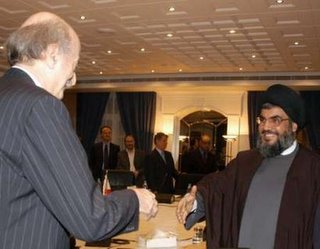
Wednesday, March 08, 2006

Hizballah needs to decide whether it is Lebanese!

I think Lebanon may gain a lot by being somehow hezbolla-ized. Many of the party leaders have a lot to learn from Nasrallah, in term of social awareness, charisma, disinterest in bribery, coherence and discipline in his ranks...
That brief statement was part of Why Discuss's response to the last entry, titled Hizbollah-ising the Lebanese State. It is nonsense. It is a useless counterargument because it completely misses the point.

Why Discuss would have us believe that this entire conflict is about Hassan Nasrallah's charisma, his social awareness, his disinterest in bribery, and the coherence and discipline of his ranks. So the Hiwar el Watani has come about because the March 14 forces simply could not bring themselves to accept such a political entity in the government and consequently, refused to cooperate. That type of counterargument, my dear friends, is unfortunately a typical format used most diligently by the nuisance of a commenter Victorino de la Vega. It deliberately eludes the point of the intitial argument in order to distract the reader and draw his or her attention somewhere else.

The point of contention between Hizballah and the overwhelming majority of Lebanese, is not over its bureaucracy, or the charisma of its leader, or the "coherence" (whatever that means) and "discipline" of its ranks. The point of contention is over Hizballah's military wing:

  • Hizballah has a para-military force of about 20,000 - 30,000 men (compared to Lebanon's 60,000-man Army) - most of which are reserves, but never-the-less well trained.

  • Hizballah has a global network of sleeper cells that are intended to carry out attacks and assassinations if and when they receive the orders to do so.

  • Hizballah's arsenal includes thousands of rockets that target Israeli settlements, towns and cities.

  • Hizballah funds Palestinian organizations

  • Hizballah is purportedly training the militia of Musa el Sadr in Iraq

  • Hizballah possesses intelligence services that work in Lebanon in order to "protect its flanks," and in doing so, spy on other Lebanese.
In reaction to the pressure exerted on Hizballah to disarm, it is common to hear the following from the Lebanese Shi'a population:

"baddun e ashtoulna sla7na" (they wanna take our weapons away). Well I would LOVE to ask the following question in response:

WHY THE HELL DO YOU NEED THESE WEAPONS???

or rather,

HOW DO YOU BENEFIT FROM THESE WEAPONS???

Okay, Prestige... and Pride... we understand - but how else?

Let me ask those Lebanese who defend Hizballah and its right to bear weapons: Why does Lebanon need sleeper cells in Argentina, Chile, Germany or the US? How are Hizballah's cells in those countries a benefit to Lebanon's national security? If you think that those cells, the rockets Hizballah has positioned in the South, and the men that Hizballah sends to train militias in Iraq are meant to protect Lebanon, you are a fool!

I lived in Lebanon throughout the 1990s. The level of coordination between Hizballah and Syria was SICKENING!!! I was there when the Israelis withdrew, and we all celebrated the fact that Lebanese land was liberated AND that we would no longer have to fight a war in the South. Do you know how it felt when Hizballah declared - OH WAIT, WE JUST REMEMBERED, WE STILL NEED TO LIBERATE THE SHEB'AA FARMS!

That was disgusting - and that was the beginning of the end of Hizballah's legitimacy in Lebanon.

HIZBALLAH NEEDS TO DECIDE WHETHER OR NOT IT IS LEBANESE. That is it! That is the decision that Nasrallah needs to make today. The Shia need to really ask themselves WHY THE HELL DO THEY NEED THOSE WEAPONS - AND HOW DOES IT BENEFIT THEM? The Shi'a should also ask themselves whether those weapons actually harm them.

If Hizballah's leadership decides that it is not Lebanese, then the Lebanese, led by the Shi'a population, should unite and either force it to become Lebanese or expel it from our country.

Tuesday, March 07, 2006

Hizbollah-ising the Lebanese State

Their attitude [on joining the government] is a dramatic change from the past. But they are going to instrumentalise the state to protect the resistance. They know how difficult it will be for the U.S. and Israel to mess with them. The party is not becoming “Lebanonised”; rather it is “Hizbollah-ising” the state.

That was what Amal Saad Ghorayeb told ICG interviewers on June of 2005. Her short analysis was eventually confirmed by a speech Nasrallah gave in UNESCO on February 16 of 2006 (two days after the February 14 commemoration of the late Rafik el Hariri). He said something to the effect that Hizballah would support a strong Lebanese state on condition that it is guided by a clear, unambiguous strategy.
.
I do not recall whether he articulated exactly what that strategy would be; but he did not need to. Nasrallah gave (and continues to give) Lebanese two choices:
  1. Either maintain the current paralysis and a weak Lebanese state
  2. Or gain a strong state with more centralized authority at the expense of what Saad Ghorayeb termed: the "Hizbollah-ising" of the Lebanese state.
Anyone with half a sense realizes that Hizballah will not compromise. The organization barely flinched even as Lebanese personalities and politicians that opposed its position died at the hands of its stalwart ally in Damascus. If even in the face of such brutality, Hizballah refused to cave in, then what exactly will induce it to compromise?
.
Once Hizballah gets its way, Lebanon will simply return to the same condition it was in under Syrian tutelage. Those who oppose the Syrian-Iranian-Hizballahi agenda will be forced to shut up or leave the country. Those who remain will be forced to benefit from the status quo to the greatest extent possible. The "resistance" will become an untouchable topic, and Lebanese will be at the mercy of its political calculations, and the Israeli reprisals.
.
If the Lebanese state is Hizbollah-ised, there will be no need for the Syrian Army, or the Mukhabarat... Simply put, the Syrians would have accomplished their mission.

Monday, March 06, 2006

Hiwar Al-Tourshan!

Today Jumblatt spoke at the Brookings Institute in DC. I was there and heard what he got to say.

In my mind now, I am thinking whether the Hiwar back in Beirut was truely a trap after all, a trap to lure all the players to agree to Hizbullah's terms.

Basically Jumblatt revealed the deal that Hizbullah has put on the negotiating table: They will give up the Presidency, if the March 14 bloc agrees to drop the issue of the Shebaa Farms, and by that agreeing to the continuation of Hizbullah's resistance role.

If that's the deal put on the table, well, Jumblatt has revealed it to all of us. He is here, in DC, invited by the U.S. Administration so they could listen to his point of view. When asked what would he demand of the U.S. Administration, he said that as a free Lebanese citizen, he will ask for support to continue on with the Cedar Revolution, namely support through pressuring the Syrian regime diplomatically and economically in order for its President to recognize that Lebanon is a free, sovereign country and that it should be left alone.

Such tough language towards the Syrian regime would not have come if it wasn't for the Syrian President's talk aired yesterday evening on Lebanese TV. President Assad talked at length about his opinions towards the outcome of the Lebanese dialogue that is taking place right now in Beirut. He said that those at the meeting should come out of the dialogue with "black and white" answers to important issues about the Resistance and about the Lebanese-Syrian relations. Bashar had the audacity to even defend the "lame duck" Lahoud and explain why he has called for renewing his term (because he defends the Resistance and has helped Lebanon not veer away from its Arabist agenda!). But what shocked me the most was when he said that this ongoing dialogue will determine where each party stands. He has already decided that this dialogue will lead to polarization!


أنا لا أرى أن التيار القومي والمقاوم سيذهب باتجاه أن يقول اننا نعم اتفقنا على قبول التدخل وعلى حل سلاح المقاومة وضرب العلاقة مع سوريا. إما أن تأتي الأمور بهذا الاتجاه وإما أن يكون هناك انقسام وفشل كما سميته الفشل الذريع


My question is why is President Assad doing what the Syrian regime always did, namely dictate to us what needs to happen and what needs to be? We say: President Assad: Leave us alone!

But to return to the issue of whether this Lebanese dialogue has been sabotaged, I was thinking how on the first day of the dialogue, Parliament Speaker Berri was quick at publicizing to everyone that all players have agreed that the Shebaa Farms belongs to Lebanon. Yet, Jumblatt, since he left the country, has questioned this premise, including his representative at the dialogue table, Information Minister Ghazi Aridi.


إنه ليس صحيحاً على الإطلاق أن اتفاقاً تم بالإجماع حول لبنانية مزارع شبعا، أبداً
أبداً. هذا الموضوع كان حوله نقاش، لكن لم نصل الى اتفاق حول تثبيت لبنانية مزارع
شبعا بقرار بالإجماع، وهنا لا بد من الانتباه الى هذه المسألة، فالحوار ما يزال
مستمراً بأجواء هادئة وصريحة


Which leads me to believe that in reality, nothing has been agreed on yet.

Publicizing that all have agreed that the Shebaa Farms are Lebanese, was a clear signal to Syria that it can relax about the urgent demand to demarcate its borders with Lebanon and a clear signal that Hizbullah's arms are there to stay. Interestingly, in the newspapers we read today that Syria's Foreign Minister Moallem has reiterated that the Shebaa Farms are Lebanese. We say: Can you please head to the UN and provide the proof once and for all and relieve us of our chagrin?

After I attended the Jumblatt event, I quickly returned to watch the Lebanese news. Already reporters were hailing a flurry of questions on the politicians involved in the national dialogue, asking them whether Jumblatt's request for U.S. help is a blow to the dialogue. The politicians said that they need to read his statements first, others said that all is being discussed on the table...

Jumblatt was clear; he said what many Lebanese are thinking and feeling, what many Lebanese aspire for regarding their country. We want an independent, free, democratic Lebanon, a Lebanon with a Lebanese agenda, and a President with a Lebanese agenda who is the final arbitrator amongst all factions and parties. Lebanon cannot solve the Arab-Israeli conflict; at least it cannot do it through violent means. Lebanon cannot defend any country's nuclear arsenal. Lebanon cannot defend a dictatorship against another. Lebanon needs a state that is sovereign, able to defend its territories when needed, without the need for others' arms on its land.

Naseer As'ad wrote today in Al-Mustaqbal, trying to draft a win-win scenario for this ongoing dialogue. He claimed that perhaps a "road map" can be devised where Hizbullah will disarm gradually, within a certain context of the Taif Accord and UNSCR 1559. I couldn't finish reading!

I'm aware that if this dialogue comes out with positive outcomes, Lebanon will be better off and Lebanese will be better off. Nothing can be solved in day or two; everything takes time. But right now, there is so much going on for me to be able to process at once. I'll wait a day or two...before making up my mind.

"Nobody knows how many rebellions, besides political rebellions, ferment in the masses of life which people earth."

Sunday, March 05, 2006

Lebanese Engineers in the Gulf

Almost as if on queue, I bumped into this interesting piece of information:

In January of 2006, the Khaleej Times interviewed a high-ranking member of Lebanon's Contractor Association by the name of Sa'did Fathah. Mr. Fathah claims that over 9,000 Lebanese construction engineers are currently employed in the Gulf, and that 3,000 of those were hired in either 2004 or 2005.

Of course, statistics in Lebanon are almost unheard of... so this man's claims stand out because he presents numbers. But, to be honest with you, the impression I get is that the numbers he presents are quite miniscule.

Lebanon... the hospital of the Middle East?

In times like these, when Lebanon's head political honchos are sitting around a table with the express intent of preventing a civil war, economic news may seem a little mundane! But no matter what the eclectic collection of god's representatives on Earth like to preach, money makes the world go round, and therefore, matters of the "Green" always deserve their little space in the headlines.

Last week, the Clemenceau Medical Center opened its doors in Beirut. It is the first clinical facility in Beirut that is affiliated with Johns Hopkins Medicine International, or indeed any other international organization of such caliber. The press release that was issued on the day of the opening read as follows:

CMC aims to be the creator, applicator and the forerunner of a new healthcare concept in Lebanon and the region. The Center is a unique health complex with a multipurpose high-tech hospital, fully-equipped with International standards.... CMC has the facilities and services to cater to the needs of patients from Lebanon and the Middle East. Virtually, all medical services a patient might need - doctor visits, testing, surgery, and hospital care - are available under one roof at CMC....
Sounds great, doesn't it? Except I wonder where all those Arab patients are. From what I hear, Lebanese doctors have formed little "mafias" to prevent new entrants into their field of specialty and protect what little clientele they already have... most of whom are Lebanese!

It is obvious to all of us... Lebanon's potential lies in the medical field. Yet, for some reason the political elite has not exploited that potential! Every mom and pop in Lebanon grooms their children to become either engineers or doctors... and the glut of professionals that this Lebanese obsession has created in both fields is immense! However, whereas engineers actually need to go somewhere to build a structure, or do whatever it is they specialize in, patients usually come to doctors! And the all mighty knows, Lebanon has a lot of doctors!

Where are those patients?!?!?! Why isn't the Lebanese government taking more steps to facilitate the process of traveling to Lebanon for a bypass heart surgery? Why hasn't Lebanon become the hospital of the Middle East? Oh wait... I know... we're too busy dealing such life and death issues as the Shebaa farms, and inter-sectarian one-upmanship!

Another top ten list Lebanon can be proud of

The Associated Press has released a top ten list of the most "lucrative" bank roberies in history. Yup, you guessed it, Lebanon has its place secured in this ominous list... Just scroll down and check it out! On another note, notice how four of these heists took place in England, and that even the Beirut heist was at the British Bank??? hmmm...

  1. $900 million in U.S. bills and as much as $100 million worth of euros Iraq Central Bank, Iraq, March 2003. The thefts took place at the beginning of the U.S. invasion and were blamed on members of Saddam Hussein's family.

  2. $92 million Security company cash center at Tonbridge in Kent county, southern England. The Bank of England said Feb. 22, 2006, the robbery had occurred overnight.

  3. $70 million Central Bank in Fortaleza, Brazil. Theft occurred sometime during weekend of Aug. 6-8, 2005.

  4. $65 million Knightsbridge Safe Deposit Center, London, July 12, 1987.

  5. $50 million Northern Bank, Belfast, Ireland; Dec. 20, 2004. Widely blamed on the Irish Republican Army.

  6. $37.5 million in gold Brinks Mat Ltd., Heathrow Airport, London, Nov. 25, 1983.

  7. $30 million Bank of France, Toulon, France, Dec. 16, 1992.

  8. $21.8 million Brink's Securmark, Rome, March 24, 1984.

  9. $20 million to $50 million British Bank of Middle East, Beirut, Lebanon, Jan. 22, 1976. The theft took place during the Lebanese civil war and was widely blamed on PLO factions.

  10. $15 million in certificates of deposit Bank of Sepah-Iran, London, January 1983.

Thursday, March 02, 2006

Lebanon: To Be Or Not To Be?

It's not Lausanne, not Taif, not in Damascus, nor in Cairo...It's in Beirut where the Lebanese leaders are meeting to determine the fate of our country. This is new. And interestingly, it's in the heart of Beirut, that heart that was flattened during the war, where they are meeting to determine that fate.

Will they come out with a document that paves the way for instituting the Third Republic? Or will they agree to finally and at last fulfill the mandates of the Taif Agreement that brought about our Second Republic?

Many questions; the fate of this country does rest on the outcome of this meeting. If this meeting fails, we have much to lose. What will the leaders who supposedly represent us decide? Will they decide to agree and save this country or will they disagree and then what?...we enter into the unknown?

And if this meeting fails, it will be even more depressing to see that perhaps Lebanon as a country, as a nation, is a failed idea. Because when the Lebanese are sitting face-to-face without foreign interference on Lebanese soil, they cannot agree on the basics?! Then what is the message we are sending to ourselves and to the world? Then why would anyone be on our side and why should I continue carrying the banner of Lebanon?

But of course if those leaders dialoguing right now come out with a positive outcome, it will be truely a "victory", even if it was symbolic, that Lebanon can be.

We can make fun of the characters taking part in this dialogue; we can mock the dialogue itself as much as we want, but I believe that history will only tell that what Lebanon is undergoing is historical indeed and worth witnessing in earnest.

On a lighter note: Check it out this picture from today's meeting:

"Nobody knows how many rebellions, besides political rebellions, ferment in the masses of life which people earth."

8 Oranges

In a somehow pioneering idea for Lebanon, some supporters of the FPM have started a major effort to offer multiple services and products in the Lebanese market, under the umbrella of 8 Oranges. They officially declare that a portion of the profits goes to the FPM.

There is a similar, obviously more developed, experience in Italy, where the Lega (League of Cooperatives) is associated with the Left parties, the ConfCoop (Confederation of Cooperatives) is associated with the Catholic center-right parties, and AGCI, the Association of Cooperatives, quite small compared to the other two, is associated with the Republican parties. Some of these also include agricultural COOP's and the like, but I'm interested in the markets. Any info is welcome. I asked some friends living in Italy and they told me that the hard line supporters of each party shop exclusively at their party’s market, while other people go for the best deals.

Back to 8 Oranges, their services include fuel, water, kiosks, and a loyalty card with which you get insurance… Check the site.

Wednesday, March 01, 2006

Nassib Lahoud For President!

Nassib Lahoud has announced his candidacy for the Presidency, if the March 14 bloc supports his candidacy...or else, he would support any candidate that the bloc backs.

I personally support Nassib Lahoud for President!

"Nobody knows how many rebellions, besides political rebellions, ferment in the masses of life which people earth."

Sunday, February 26, 2006

New TV

New TV news editors should really get a life. I had heard much about the remarks they make during their evening news and I am already sick of the propaganda/filtering/selectivity on Future and LBC, so I thought I’d give NTV a try. I picked the worst day, which was when Rice came to Lebanon.

NTV actually dedicated more than 10% (3 - 4 minutes) of their evening news duration to the bashing of PM Saniora for, get this, kissing (on the cheeks) Condi Rice. Around the end of the news, there was a banner at the bottom of the screen “Hajj Fouad kisses Miss Condoleezza”.

So I stayed and waited, the news item went on something like this:

“PM Siniora insisted today on kissing US Secretary of State Rice on both cheeks……” then some more talk about personal remarks during the visit and then “Just a reminder, people coming back from the pilgrimage to the holy sites should refrain from touching women.”

Again, NTV people. Get a life.

Found on Tayyar.org


The FPM site has this small announcement in the right-hand column.
Roughly, it translates "To our people who have sought asylum in Israel, please email returninghome@gmail.com for help in the return to Lebanon."

Friday, February 24, 2006

The Price of Politicizing Religion

Over the past three or four decades, Islamic “vanguards” have successfully propagated their notion of political Islam. According to these radicals, Islam offers solutions to such wide-ranging problems as the Arab-Israeli conflict and the very practical matter of putting bread on the table. Unfortunately they have successfully convinced considerable portions of Muslim populations all around the world to buy into their rhetoric. These societies have offered such organizations as Hizballah, Hamas and the Muslim Brotherhood legitimacy and authority that any secular leader or party would salivate over. What the average Muslim did not expect was the price their religion would have to pay for this process of politicization.... Thus far, that price has been extremely high, despite the fact that political Islam has only picked up steam in recent years.

Politics is universally referred to as a "dirty game." It is referred to as such for a good reason too. Politics is usually a no-holds-barred slugfest between the powerful, where almost no position or principle is too sacred to compromise or be trampled over. That is the nature of the political game. It has been as such since time-immemorial and will remain as such until the time of men on earth has come to an end.

Through politicizing Islam, Islamic radicals have subjected the religion they purportedly love so much to the nature and whims of politics. The prophet Mohammed no longer remains a religious figure who inspires reverence among believers and a mysterious curiosity among nonbelievers. Rather, the prophet becomes a political figure who is revered by his followers but despised by those who stand to loose from the agenda they perceive him to espouse.

Another contentious issue becomes who decides what is politically "holy" and what is not? A very good example of such a "conflict of holiness" manifested itself in the February 14 demonstration when Walid Jumblatt proclaimed that "their holy causes are illusions...." Of course, Hizballah’s leadership thought that by covering "the resistance" with a shroud of divine legitimacy, they would protect themselves politically. But alas, they miscalculated, and the nature of politics overruled their religious assumptions. The question to ask today is who do you blame: Hizballah for using Islam to legitimize its political position, or Jumblatt for doing what politicians do and openly disagreeing with Hizballah's "divine" position?

As the disturbing events in Iraq over the past few days have proven, even religious sites are not immune. The al Askariya mosque was targeted because of its political value. Had religion been irrelevant in Iraqi politics, why would mosques be targeted in the first place? Furthermore, if the al Askariya mosque was targeted, what is to stop Mecca from being targeted in the future? The politicization of Islam politicizes Islamic holy sites as well. Consequently, today (politically speaking), Mecca has become the equivalent of White Hall in London, the Bundestag in Germany and Congress in the United States.

There is a very famous cliché that most of us have heard: "nothing is for free!" The price of politicizing Islam will be extremely high on the religion itself. The insults will continue, the destruction of mosques will not abate, and the whole notion of “holiness” will lose its meaning since so many people will attribute it to so many different contradicting political causes. I doubt this is what most Muslims want for their religion. In fact, I doubt this is what any faithful person wants for his or her religion. I was raised to believe that religion is above politics. Maybe I am different; but considering the costs of the politicization of Islam, I believe that faithful Muslims should reconsider their support for Islamic radicals who seek political prominence by raising the banner of Islam.

Thursday, February 23, 2006

Lahoud on the way out, but not quite there yet..

Secretary of State Condoleezza Rice's choice to hold her first meeting with the head of Lebanon's Catholic Maronite Church is indicative of the current U.S priorities towards Lebanon. The Patriarch plays a central role in determining the fate of the presidency and has only recently moved to de-legitimize President Emile Lahoud's mandate. Equally telling is her decision not to meet with the Pro-Syrian Lahoud as she had done on her prior visit.
.
Now that Patriarch Sfier has clearly stated that current conditions surrounding the presidency must not continue, the debate between pro and anti Syrian parties is likely to shift from whether or not to ouster President Lahoud to trying to find a compromise candidate. Yesterday's visit by the Qatari Foreign Minister to Beirut and Damascus may be an attempt to broker such a compromise. It is not entirely unimaginable that Damascus might try to bargain and compromise over Lahoud's fate rather than wait until next year and see his term expire in return for little.
.
In any event although it's not quite a done deal yet, Lahoud seems to be on his way out. It is increasingly unlikely that he will remain in office until the end of his mandate, but domestic and regional negotiations regarding a replacement may take weeks or even months.
.
We will retain the pleasure of having him in the Presidency (sarcasim of course) as the March 14 deadline comes and goes.

Wednesday, February 22, 2006

From Baabda To Mathaf: First Things First

Per protocol, the Cabinet will convene tomorrow Thursday evening, but this time around not in the Baabda Palace, but in a temporary location in the Mat'haf area in Beirut.

Why? The majority of the Cabinet ministers unanimously agreed not to visit Baabda while Lahoud is in power.

The first, tangible steps taken by us, Lebanese, to say: Lahoud, Tla3 Barra!

But there's more: Parliament Speaker Nabih Berri has been sending invitations to prominent heads of parties and parliamentary blocs to join the negotiation table (tawilat al-hiwar). President Lahoud is not invited! He, unfortunately, does not even qualify to play the role of the national mediator; he has taken sides far when he endorsed the Ain El-Tineh Gathering last year.

Our President has truely lost his Lebanese legitimacy!

"Nobody knows how many rebellions, besides political rebellions, ferment in the masses of life which people earth."

Arabs and Muslims should look at the mirror more often!

The attack on the Askariya Shrine in Iraq today is another major blow to the Arab and Muslim propaganda machine that has struggled for decades to draw the world's attention solely on Israeli infringements of Palestinian rights and, more recently, the "Western" attack on Islam.

When this propaganda machine screamed that Arab-Israelis were treated as second class citizens, all we had to do was point to the Copts in Egypt, who up to this day cannot even build community centers because their Muslim neighbors will suspect that they are building churches....

When this same propaganda machine screamed that the Israelis ethnically cleansed Palestinians from their homes, all we had to do was point at Saddam's actions towards the Kurds and the Marsh Arabs, who were victims of systematic ethnic cleansing campaigns....

And now, when this propaganda machine screams that the Israelis and the West are deliberately targeting Islam by desecrating its prophet and holy sites, and plotting to blow up the Dome of the Rock or nuke Mecca, all we have to do is point to al Qaeda - the only organization on this Earth that has successfully managed to blow up one of Islam's holiest sites!

Typical Arab Response: Hey let's go protest against those damn Danes, and destroy some Churches while we're at it!!! What do you say?!?!

Tuesday, February 21, 2006

Fellow blogger creates new and improved website

Fellow Lebanese Blogger Qais has just changed his url address to http://www.beirutbeltway.com/

His new website is definitely an improvement over the old one, so the change was definitely worth the inconvenience that comes with a different url.

To sweeten the medicine a little, Qais has also published an entry concerning threats that the Dailystar recieved from the Syrian Mukhabarat to publish those ridiculous Op Ed pieces that Butheina Shaaban wrote.

Check it out!

Monday, February 20, 2006

A Year Since We Started Writing...

I remember a year ago, Raja and I were boiling with energy...we wanted to take action. There were people on the streets in Lebanon, and we were here stuck watching TV. We wanted to take action, to take part in history-in-the-making.

Raja called me at work and told me to start writing; he set us a blog. I was reluctant to write, knowing that once you write something on the blogosphere, you are exposing yourself to the whole world. Yet what is interesting is that there is instant gratification in receiving comments from readers and by that creating dialogue and conversations we so much needed while away from the homeland.

I opened up and started writing. My first post is entitled: My Thoughts. Dated February 21st, 2005.

We started by inviting other friends onto this blog: Reem, Firas, May, Hassan, Hani G, Lea. Some wrote, some commented, some left us, but Raja and I continue to feel an obligation to write. Our circle of friends have widened, friends we made through this blogosphere, friends whom we would not have met ever if it was not for this venue. I can say that through this blogosphere, we have created a new "community" of Lebanese open to dialogue, willing to bounce off ideas and to expose their beliefs and thoughts for criticism and further analysis.

For a year now, we've witnessed the ups and downs of politics in Lebanon, being reflected on this blogosphere. So we've seen it through the rough tides. And we continue to have hope. I believe that hope is what characterizes our spirit and outlook towards Lebanon. After all, we want to return to Lebanon and this blog is one of the tools of engagement.

I want to thank everyone who continues to read our posts. You are what has made this blog make it through its first year. I want to also thank our fellow bloggers and my fellow writers on this blog.

And finally, a large, special thanks to Raja. Happy Birthday! Looking for another year of the same!


"Nobody knows how many rebellions, besides political rebellions, ferment in the masses of life which people earth."

Happy Birthday!

I just wanted to announce that today is this website’s first Birthday. Yup, this blog is officially a year old! When it actually dawned on me that we reached that milestone, I couldn’t believe it! I never thought we would last this long…. I never thought I could last that long! I have to extend my gratitude to all of the Lebanese bloggers, commenters and visitors for keeping this blog and the Lebanese Blogosphere alive. We have all taken part in creating something new… we have helped to enrich Lebanon’s presence on the World Wide Web, and created a new medium for Lebanese across the sectarian divides and from all over the world to communicate through. We have essentially created Lebanon’s little space in the World Wide Web.

The first bloggers I discovered that remain active today were Tony at Across the Bay, Mustapha at Beirut Spring, LP and CG at Lebanon Political Journal and the guys at The Lebanese Blogger Forum. Today the Blogosphere grows on an almost monthly basis.

Lots of blogs came and went, but some stayed with us. From Beirut to the Beltway, Letters Apart, Lebanonesque, Welcome to my Dream, Cedars Awakening and Ms. Levantine are all blogs that I discovered along the way and continue to visit as they post more entries. New blogs have also emerged more recently. Beirut Notes and Jamal’s Propagandas Site come to mind, so does the infamous ;-) French Eagle! The Lebanese Blogosphere has also been enriched with the words of foreign bloggers who share with us a passion for our country and region.

Stacey continues to provide us with her insightful entries; Michael Totten's blog is always a treat to visit, and Joshua Landis.... Ohhhh… Joshua Landis. Where would the Lebanese Blogosphere be without Joshua Landis??? the blogger who eventually turned himself into the Lebanese piñata, and at a certain point in time inspired around half of our entries (which were written in response to some of his provocative and, to put it mildly, pro-Bashar entries).

Partially thanks to this spur of activity in the Blogosphere, the World Wide Web now hosts new websites such as Ya Libnan and The Lebanese Lobby News Website. Ya Libnan started off as a blog and is now a full-fledged news website. The guys at the Lebanese Lobby also do a great job at keeping all of us informed about Lebanon and Lebanese who live and work abroad.

And finally, let me just say that nothing sustains the Lebanese Blogosphere like OpenLebanon.org. The website that does so much, and can do so much more!

Guys… let’s all keep this up! I look forward to more blogs and websites. Lebanon, with all its wonderful diversity and painful contradictions is finally exposing itself to the world through the World Wide Web. In this case, all I can say is the more the merrier… so bring ‘em on! :-)

Don't overblow Lebanon's Democratic Problem!

Some in the Lebanese blogosphere have proclaimed the consensus candidate for Ba'bda Aley as a 'cataclysmic' blow to democracy. I respectfully disagree; but even if I did agree with that assessment, so what???

Lebanon's problem is not related to democracy. I repeat... Lebanon's problem is NOT related to democracy. Maybe the Syrian and Saudi problem is their lack of democratic institutions, but the Lebanese problem is not. Every democracy on this Earth possesses authoritarian elements - elements that thwart the "democratic will."

In the United States, you have the Supreme Court, the court system and the US Constitution, all of which form essential components of the "checks and balances" system, which was explicitly designed to thwart the democratic will. A less intentional and more sinister authoritarian element in the United States is the duopoly of the Republican and Democratic parties, and the fact that the system is extremely friendly to incumbents. I'm not too sure about numbers, but it is a well known fact that only an extreme minority of seats in both houses of Congress are actually contestable. The rest of the seats… well, just take a good look at Ted Kennedy.

What do the theorists say about this? Well, they don’t seem to agree. Democratic theory is more like a spectrum than anything else. On one end, are those theorists who claim that a democracy should amount to nothing more than "competition between political elites," in which the only democratic institution available to the regular citizen is the right to vote. On the other end, are those theorists who claim that the vote is inherently undemocratic because it delegates politics to "representatives," as opposed to maintaining it in the hands of the citizen.

I tend to agree more with those who claim that democracies should be limited to a competition among members of the political elite, in which citizens hold them accountable for their performance. Consequently, I disagree with those who assert that the major problem in Lebanon is its democracy (or, a lack thereof). Rather, I argue that the real problem lies in Lebanon's authoritarian institutions (the authoritarian elements within the country’s democratic system).

For example, rather than rely on the Supreme Court for checks and balances, we rely on the Sects to balance each other out. And, rather than rely on the institution of meritocracy, we rely on nepotism. And rather than rely on a secular code of laws that regulates the “personal status” of all citizens, we rely on religious courts that pay no respect to individual rights and other modern rights such as those pertaining to women.

Therefore, the calamity in Lebanon does not lie in Ba’bda Aley or the country's democratic system. Arriving at a consensus candidate is a normal development in all democratic systems. In Lebanon, the real calamity lies elsewhere….

Friday, February 17, 2006

Headed for the slopes, my friends


I am off to the slopes of West Virginia! Will be back on Sunday.

See you all later!Posted by Picasa

Update:

I just got back. It snowed, the temp was bellow 10 fahrenheit ( - 12.2 celsius), and it was windy. Despite those murderous conditions, I had fun!

A couple of words about the slopes. First, they are called "Timberline". For those of you who have been to Farayya in Lebanon, a good comparison would be Junction! I basically snowboarded on one hill that was maybe twice as wide as Junction and 1.5 times as high.

What I found really cool though, was that people skied and snowboarded on 6 or 7 paths that were cut through the forest which covers the hill. So I had really tall and dense forest on either side of me all the time. That experience was both new and fun.

Cool Stuff! Definitely not Lake Taho nor even Farrayya... but, cool stuff!

Now, back to the grind!

The Outcome Of February 14 And The Strong State

Has the February 14 rally in Martyr's Square made a difference on the political arena in Lebanon? And are we seeing the results of gathering hundreds of thousands on the streets that day paying off?

Well, perhaps we are witnessing a change!

First, Aoun met with the Lebanese Forces MP Adwan yesteday in Rabieh to discuss the list of potential candidates that can be agreed on for the upcoming Baabda/Aley elections to fill the vacant Parliamentary seat that the late MP Edmond Naim left behind.

Aoun and MP Adwan have been meeting since Aoun returned to Lebanon. But what was so different about yesterday? In a press conference, Aoun announced that his bloc and the Lebanese Forces will disclose on Sunday the name of the candidate they agree on; they are giving themselves until Sunday to decide on one.

So how come now Aoun is negotiating with the Lebanese Forces on this Parliamentary seat, when two weeks ago, Aoun blurted that this particular election race will be negotiated between his bloc and the Future Movement, and by that totally disregarding the Lebanese Forces, which in reality had won this seat during the past Parliamentary elections? Was this new move a sign that Aoun recognizes the popular weight of the Lebanese Forces, after it succeeded to bring thousands upon thousands of its supporters out on the streets last Tuesday?

Second, yesterday Sayyid Nasrallah started out his speech in UNESCO with a conciliatory, soft-spoken tone. He said that he supports the importance of dialogue and that the resistance has always fought for Lebanon (al-watan) and will always do. He even denied that Hizbullah is affiliated with the Syria-Iran axis and that reports claiming that he said Hizbullah's arms are tied to the regional settlment with Israel are twisted and not entirely true!

We can take from his conciliatory tone that Hizbullah is open for dialogue and will negotiate on its arms. A direct result of February 14? I'm sure, some would agree and some would not.

But to move to another point regarding Nasrallah's speech: Sayyid Nasrallah said that he supports a "strong" state, a state with "strong" strategic policies. I asked myself, what he meant by "strong" and whether the Lebanese state could ever be "strong" in a foreign-policy sense (which is what Nasrallah is alluding to).

Is it that what he means by "strong" strategic policies, is basically facing up to the West? Does it mean that the Lebanese state should ally itself with the axis of "Ghaza, Lebanon, Syria, Iran, Venezuela" (as Sayyid Nasrallah described in his speech, this axis versus the Tel Aviv-USA axis)?

Lebanon, in my view, cannot be a strong state in that sense. Neither its size, nor its "coexistence formula", let alone its democractic political orientation, will land us a strong state with provocative strategic stands.

Our state can and should be "strong" in attempting to forge a unified notion of what constitutes a Lebanese citizen. This is where the state plays an important role, a role our state has not played successfully since its inception.

"Nobody knows how many rebellions, besides political rebellions, ferment in the masses of life which people earth."

Thursday, February 16, 2006

Such a long meeting!

Today on LBC, I watched a report that covered Seniora's visit to the Vatican. Something caught my attention about the report. LBC insisted on inserting the following into its report:

Seniora met the Pope for 30 minutes, which is unusual because the protocol calls for meetings to last for five minutes only.
LBC then reported that
Seniora went on to meet the Vatican's Secretary of State, in a meeting that lasted for 50 minutes, which was also unusual because protocol also calls for meetings to last for (if I remember correctly) five minutes.
Interesting, no? Of course, LBC could have chosen not to mention those nuances, just like Future TV chose not to mention that the Iranian official visiting Lebanon paid Hariri a visit. By the way, one of my favorite past-times has become watching Future and LBC and comparing the coverage of the same events. I just love doing that.

But going back to Seniora's meetings, and disregarding the question of LBC's coverage... Why were those meetings so long? I've heard of previous political roles that the Vatican played in the past (e.g. intermediary, messenger, etc...). Could they be playing one of those roles today?

Oh I know, they were probably trying to appeal to Seniora's Italian roots to do them a favor or something of that nature. Italian roots you ask... Well how do you think he got that last name???

Totally Different Subject...

I find it fascinating when Hizballah claims that no such thing as a Damascus-Tehran-Hizballah alliance exists on the very same day that the Iranian foreign minister visits Lebanon. How blatantly could your lie be?!?!?! C'mon tell the Iranians to come a week later or so, so that what you said may sort of fade in our memories...

And Finally...

I noticed that Nasrallah reaffirmed Hizballah's God-given right to resist. Okay, no comment... except of course, this is just one example of the problem that accompanies the participation of religious men in politics.

Step back and be amazed

Be proud of your fellow Lebanese, and never forget what they accomplished in February 14. Think of Jumblatt's speech, but forget Jumblatt, and focus on how your fellow Lebanese reacted to what he called for:

- They all cheered when Syria was challenged
- They all cheered when they heard that Lebanon was the only real sacred cause
- They all cheered when they heard "Lebanon first"
- And finally, they all chanted, "bil rou7 bil dam, nafdeeka ya Libnan"

Take a step back, and realize what your brethren have accomplished. Forget the politics of the political class; forget all the problems that Lebanon still need’s to face; and ask yourself: would you ever have thought that such a thing could have happened if you were politically aware in the 1950s and 60s? Moreover, I would bet you all of my money (very little, by the way) that had Martyr's Square been filled with Shi'as they would have cheered as well (of course, the conditions being that they not feel threatened as a sect and that they not be Fundamentalists).

For all my cynicism and disgruntlement with Lebanese, I have to give them credit for what they accomplished on February 14th. If we take one step back and look at things in their historical perspective, we would definitely be proud of the steps they have taken. At the very least, today "Lebanon First" resonates with almost everyone!

Hurray for Lebanon... Bravo ya Libneniyyeh!

Wednesday, February 15, 2006

Coexistence vs. the secular society

In light of yesterday's developments, it was almost inevitable that the subject of coexistence vs. the secular society be brought up. Therefore, I have decided to introduce it into this forum.

In my humble opinion there are two main questions that need to be answered:
  • Are you willing dismiss everything you've been raised to believe regarding family and religion, in order to merge with fellow Lebanese from other sects and/or regions and form a homogenous secular community?

  • Irrespective of your personal choices and beliefs, do you think that Lebanese societies will ultimately merge into one big secular society? If not, do you believe that there are enough individuals living in Lebanon today to form what is referred to as the "19th sect"?
    Please keep in mind that sectarianism in its broad sense consists of both religious and "secular sectarian" components. So all you Druze out there, disregard the religious component of the question and focus on the familial/historical components. The same applies to all Lebanese who consider themselves to be non-practicing Christians and Muslims.

    Finally allow me to pose a third question to all those Lebanese individuals who advocate for the creation of a secular community (the 19th sect):
    • The traditional communities in Lebanon have been built upon spiritual and social foundations that stretch back to a millennia and more. The secular community, on the other hand, has no such foundation. It cannot comfort its members spiritually; it cannot provide them with a structured social environment; it cannot offer them the pride that usually accompanies long histories. With all of these handicaps, how can it compete against the other sects and win "converts"?
    I have my own answers - but I will leave them until later... I know this issue is pertinent to most Lebanese who have been educated and subscribe to modern ideals and norms, so I am waiting for your responses.
    .
    My own answer: The "secular community" is not the answer and will never be the answer. I did not leave my community to join another one! I left my community to be my own master... to have my own opinions... to be free of the rules and obligations of any "community" that desires to claim me.... In short, I left my community to be a free individual - to have my own personal space to think, act and feel as I like. The "secular/modern society" can only be truly realized in Lebanon when individuality is realized. The path to what we all seem to seek for Lebanon lies in INDIVIDUALITY.
    .
    Here lies the major challenge that I think we are all acutely aware of (as Lebanese). In the first part of this entry, I suggested that the "secular community" was simply no match against the other more established communities in Lebanon. A great analogy of the secular community facing off against a traditional one could be putting a gorilla and Stephen Hawking in a boxing ring. Now imagine an individual facing off against an entire community! What would that look like? An ant challenging a gorilla?
    .
    I've read several commenters on this blog claim that some Lebanese have managed to create their own individual spaces in Lebanon. This is most likely true. Across Lebanon you are sure to find individuals scattered all over the place, happily living their lives. But the real question to ask is: will there ever be a situation in Lebanon where the majority (or even a significant minority) of Lebanese behave as individuals rather than collectives? I doubt that sort of situation will be realized any time soon.

    Tuesday, February 14, 2006

    March 14 is back!


    At first I was skeptical... The numbers were there, but the spirit seemed absent. I thought to myself: "yeah, all these guys are standing around because they followed orders and got on those busses... they're probably uncomfortable around each other, and desperately want to go home..."

    But then some things started to happen that sparked the March 14 spirit...

    • the first was Jaejae's speech. As I saw him climb up to the stage, the camera focused on the crowd and I thought to myself: "wow, who would have thought back in the 80's that Jaejae would be giving a speech to a crowd in which the majority were Sunnis and Druze.

    • the second event that helped spark the March 14 spirit was when the Shi'a MP Bassem el Saba' gave a heart-felt speech that among other things told the crowd that the "absent sect" was really present, and that it was among the crowds. His speech was among the most well-received by the gathered masses.

    • the third event that helped spark the March 14 spirit was when Jaejae saw Sa'ad el Hariri approaching the stage, then stopped his speech and said "common sheikh Sa'ad, I'm waiting for you," then Jumblatt, Jaejae and Sa'ad held their hands triumphantly in the air to the rapturous applause of the crowd. Again, when did you ever think something like that could ever happen in Lebanon? I immediately hoped that people were saying: "hey if they can do it, why can't we?"

    • the fourth event was Jumblatt's speech, in which he was able to reach out to the crowd and lift their spirits like none of the other speakers. This was the first time I've seen Jumblatt speak to a mass audience, and I was amazed at the reception they gave him.

    I know that underneath the surface the absolute majority of Lebanese gathered today in Martyr's Square identify themselves with their sects first, and are therefore sectarian. I know that after they go home, they revert to sectarian discourse and patterns of behavior. But sometimes I ask myself: "what if we had more of these events that brought all Lebanese together, from all of their sects rather than two-thirds or three-fourths? what if these events were more frequently held?"

    That is the promise of March 14... the real reason that I cling on to it so viciously and stubbornly. Because no matter how Secular Aoun claims himself to be, I simply cannot imagine him managing to pull such an event off all by himself. No matter how many Lebanese flags Hizballah provides the crowds that it gathers, I cannot imagine Druze, Maronites and Sunnis attending a Hizballah rally.

    Only March 14 has been able to bring Lebanese together in such a scale. And ironically, the two parties to thank for this development are Syria and Hizballah. For had Syria not killed Hariri, and Hizballah not been such a powerful barrier in the face of the political leaders of March 14, they would not have resorted to such measures, which in the long run may threaten their own sectarian power-bases.

    Hassan Mneimneh, a prominent journalist, once said that March 14 released a genie that the political elite may not totally be in control of. One of the potentials of this genie is that it may help the Lebanese youth who are truly non-sectarian in their outlook to create a "Lebanese Space" that is autonomous from the sects... a space in which Lebanese forgo the comforts of sectarian affiliation and push the secular and modern project in Lebanon forward.

    That is what I want from March 14. The promise of a free, modern, non-religious, non-sectarian and prosperous Lebanon!

    picture: courtesy of al Jazeera http://english.aljazeera.net

    Hundreds Of Thousands In Martyr's Square!

    I can't believe my eyes!!! Are these scenes from last year? Could this be true?

    Hundreds of thousands in Martyr's Square/Freedom Square; tens of buses still flocking from all sides of Lebanon. And yes, Achrafieh is there, taking part in this commemoration!

    We're alive; we have not been defeated. The Lebanese people's will has not been broken.

    Jumblatt is there. Geagea is there. Saad Hariri is there...

    I wish I was one with this glorious crowd, raising a Lebanese flag. Alas, I'm thousands of miles away. My heart is in Beirut today.

    It's been a year since Rafiq Hariri was brutally killed, since Bassil Fleihan left us, since Lebanon seized to become what it was for 30 years long.

    3asha Loubnan!

    "Nobody knows how many rebellions, besides political rebellions, ferment in the masses of life which people earth."

    Monday, February 13, 2006

    February 14 Candlelight Vigil In Washington DC

    To Lebanon, To Rafiq Hariri....With Love.

    Let's get together at 7:30PM tomorrow, February 14th, in front of the Lebanese Embassy in Washington D.C. to commemorate in peace a year since PM Rafiq Hariri's cruel death...

    A chance to reiterate our solidarity with all those who have been terrorized and assassinated following Hariri's assassination...

    A chance to commemorate a time that brought all Lebanese together under one banner: Truth, Freedom, National Unity!

    "Nobody knows how many rebellions, besides political rebellions, ferment in the masses of life which people earth."

    Sunday, February 12, 2006

    Putting things into perspective

    In one of my last two posts, Zwixo asked the following: okay, this is all nice, but you have not answered the question: what do we do with Hizballah?


    My answer: Isolate it. Force it to accept our conditions of disarmament.


    What Aounis are not getting is that Hizballah on its own is the most powerful political entity in Lebanon. Hariri was eliminated precisely for that purpose - to remove the other heavy-weight, so that when Syria leaves, the direction that it plotted for Lebanon to follow will not be challenged because of Hizballah.


    The March 14 coalition was created expressly to challenge Hizballah's domination! It offered a cacophony of Lebanese political parties united by a vision, but more importantly, united for the sake of being able to look Hizballah eye-to-eye.


    It was based on that position of strength that the March 14 movement wanted to engage Hizballah and negotiate with it over the past several months. Unfortunately, Hizballah maintained its intransigence despite the assassinations, played on the FPM front, and knew that if push came to shove a single party would outlast a coalition in a drawn-out conflict.


    In my opinion, had Aoun swallowed his pride, and accepted a weaker political position in the March 14 alliance than that which he expected and eventually did gain, then maybe, the March 14 coalition would have succeeded in resolving the Hizballah issue on their terms. Of course, history tells us a different story, and the FPM has striven to demolish the March 14 movement since its return to Lebanon.


    My question to Aoun and FPMers is that if the March 14 coalition was unable to bring Hizballah to heel, how the hell do they expect to do it? If they were as interested in seeing Syria's influence in Lebanon totally eliminated and militias totally disarmed, then they would have understood the game, swallowed their pride and gone along!


    But noooo... of course not! They are too clean to deal with the dirty Jumblatt and the corrupt Hariris! Besides, their first priority is to become a strong sect, and then they can deal with Syria and Hizballah.


    As we say in Arabic, khaleena 'nshouf shoo 7a yitla3 min amrun. As I said in my last post, Hizballah and Syria may have just successfully cracked the only coalition that could have challenged their dominance. Now the Maronites have their strong position in Lebanese politics, but allow me to suggest that they have just been bought off! Everything they fought for over the past 20 years has just been thrown down the drain.


    Bravo Aoun! If only you thought this way back when you were in Ba'bda fighting to the death for Lebanese sovereignty!

    Sectarian does not mean religious


    Hizballah is the only mainstream party in Lebanon that is not merely sectarian, but religious. It's agenda is not political, it is also social. Lebanese Shi'a who are secular, but defending that organization as a result of their sectarian impulses must understand the repercussions of their support.

    Do they really want to live in the society that Hizballahis want to create?Posted by Picasa

    Saturday, February 11, 2006

    Aoun's historic miscalculation, and more...

    He thinks that he can get Hizballah to bend to his will, but he will fail. Hizballah is not a Lebanese institution, it is an Islamic - Shi'a institution. It is religious, not secular in its outlook. It sees itself as much larger than Lebanon, and will not cave into Lebanese pressures, whatever they amount to. Hizballah's world view is Islamic, not modern. Modern boundaries mean nothing to it... Religious boundaries mean everything. If Aoun thinks that he possesses the capabilities to disarm Hizballah, he is wrong. They are using him to break the unanimous pressure they were under. They will buy time, and foment more divisions. They seek a reality similar to that which existed when Syria was present... one in which those calling for their disarmament are in the fringe of politics. God knows, they appear to be succeeding.


    What Aoun does not understand is that he is helping one of two mutually exclusive visions for Lebanon. He is propping up the vision of Lebanon that places it in the forefront of conflict with Israel. He is propping up the vision that sacrifices individual freedoms for the sake of war. He is propping up the vision that sacrifices economic prosperity for the sake of perpetual conflict. He must understand the price that Lebanon is going to pay for his political ambitions and coalitions.


    The Historic miscalculation of secular Shi'as


    I wish the Shi'as had a sectarian (non-religious) alternative that they could offer their allegiance to. Ideally, all of us could get a secular alternative that we, whatever our sect, could offer our allegiance to; but alas, we are not in an ideal world. Berri is simply too corrupt and self-serving to offer a viable alternative to Hizballah. Indeed it is precisely because of those weaknesses that he has become an appendage of Hizballah.

    Secular Shi'as must understand that Hizballah's vision is to vanquish their secularism. Hizballah is an Islamic party that is totalitarian. Its agenda is not just political, but social. It seeks to impose its form of social order on all Shi'as. Hizballah is not merely a sectarian party - it is a religious one.

    Are all Shi'as who offer their support to Hizballah willing to give up their personal freedoms in order to prescribe to Hizballah's world-view and social order? I think not. But if that is the case, then why do my secular Shi’a friends continue to support it? Sectarianism, of course! Hizballah is the pride of the shi’a community. But if these friends really fully comprehended Hizballah’s agenda, I am sure they would cease supporting it! In fact, they would oppose it! I hope they eventually come to their senses.

    The Campaign has Begun... I hope it succeeds!

    Today's Future TV news broadcast included a speech by Saad el Hariri that called on all Lebanese to reclaim their streets. I am not confident that the turn-out in the one-year commemoration of the Hariri's and Fleihan's assassination will be high. The "village Sunnis" are terrified because of the state clampdown on their Achrafieh rampage. The Maronite wounds may not have healed. Hizballah and Syria with Aoun's help have punched a deep dent in the March 14 political initiative.


    Yet I have hope.


    Some of March 14’s old voices have resurfaced. Bahia el Hariri, for example, spoke for the first time in several months; and her voice sparked a little flame in my heart. Amin el Gmeyyel gave an inspirational speech to followers that called on them to take back the initiative and forget the wounds of the past. The Bristol meetings, which have not been held for quite some time, have also started taking place. And finally, the new documentary about Hariri emotionally moves the individual because it shows an uncut version of the man that the Syrians so brutally annihilated.


    All these factors combined may serve to bring the Lebanese street back to life. The March 14 Street. The Street that calls for


    7urriyeh, Siyadeh, Isti2lal!


    Freedom, Sovereignty, Independence!


    Those words may echo in Lebanon once again. And I pray that they do! For the sake of Rafik, Basil, Samir, Gebran,George and every other Lebanese who has died at the hands of the Syrians and their agents, I pray that they do!

    Addendum: Fellow blogger, Firas, has just informed me that Saad el Hariri has returned to Lebanon to lead his father's one-year commemoration.

    Friday, February 10, 2006

    Suffocating Individuals

    I see no room for the individual in Lebanon. The different communities are antagonistic towards each other, but I believe that their ire is mainly directed towards The Individual.

    Most people claim that Lebanese leave Lebanon because of economic reasons. I doubt that that is the complete truth.

    People also leave Lebanon because of social reasons - primarily among those, is the desire to escape from the suffocating grip of their families and communities. They seek to live life as free individuals.

    So the immediate question to answer is: can an individual live in Lebanon today? If yes, I'd like to know how. If not, then I'd also like to know what can be done to change the situation.

    Thursday, February 09, 2006

    The Fake Outrage of the "Muslim Street"

    Egyptian Sandmonkey has stumbled upon a very interesting discovery!

    It turns out that in October of 2005, an Egyptian publication published those very cartoons that Muslims all over the world are now "outraged" about, but not a single peep emerged from the "Muslim street" back then!

    Click here to check out the Sand Monkey's Entry. He has scaned the newspaper, so there is no doubting the authenticity of his claim!

    The question we now have to ask ourselves now is WHY?

    Why did Muslims decide that it was appropriate to protest and burn embassies these past two weeks, but not in October when the cartoons were first published (in a prominent Egyptian daily mind you)?

    I have my suspicions (they're quite obvious), the Sand Monkey has his....


    Now while the arab islamic population was going crazy over the outrage created by their government's media over these cartoons, their governments was benifitting from its people's distraction. The Saudi royal Family used it to distract its people from the outrage over the Hajj stampede. The Jordanian government used it to distract its people from their new minimum wage law demanded by their labor unions. The Syrian Government used it to create secterian division in Lebanon and change the focus on the Harriri murder. And, finally, the Egyptian government is using it to distract us while it passes through the new Judiciary reforms and Social Security Bill- which will cut over $300 million dollars in benefits to some of Egypt's poorest families. But, see, the people were not paying attention, because they were too busy defending the prophet by sending out millions of e-mails and SMS-messages, boycotting cheese and Lego and burning Butter and the danish Flag. Let's not even mention the idiots who went the usual route of "It's a jewish conspiracy", spouted the stupid argument about the Holocaust, or went on a diatribe with the old favorite "There is an organized campaign-headed by the west and the jews- to attack and discredit Islam, and we have to defend it". They proved, once again, that the arab world is retarded and deserves no better than its leaders.

    Qudos to Sand Monkey for this wonderfull discovery! This type of stuff is what the Blogosphere was made for!

    Update: Michael Totten has brought to my attention this article from the Wall Street Journal that documents the Egyptian government's role in fanning the flames of protest. The article will be accessible today only, so I will copy and paste some exerpts.


    In this volatile environment, a group of Danish Islamic clerics angered by the cartoons succeeded in enlisting help from Egypt's secular government, which has been struggling to contain a potent Islamist opposition. Secular forces in the Arab world, eager to burnish their image as defenders of Islam, provided an important initial impetus for the protests, but now are scrambling to control the fury.

    ...

    Mr. Abu-Laban began working closely with Cairo's embassy in Copenhagen, holding several meetings with Egypt's ambassador to Denmark, Mona Omar Attia. "Egypt's embassy played a fundamental role," he says. Egypt and other Arab regimes saw the furor as a good opportunity "to counteract pressure from the West" and "to show people they are good Muslims," he says.

    ...

    The first delegation left for Cairo in early December. As that nation was about to hold the final round of the first democratic election in modern Egyptian history, the government was battling accusations from some quarters of insufficient piety. Ms. Attia, the ambassador, denies that authorities tried to manipulate the cartoon issue as an electoral ploy.

    Tuesday, February 07, 2006

    Why March 14 will always trump Aoun.

    March 14 sparks hope in Lebanese because it symbolizes reconciliation. Reconciliation with our past and reconciliation with ourselves. Aoun, on the other hand, symbolizes confrontation.

    March 14 sparks hope in Lebanese because it encourages Lebanese to focus on their best attributes. Aoun, on the other hand, always reminds us of our worst attributes.

    March 14 sparks hope in Lebanese because it stands up to the terrorizing Ba'ath regime that occupied us for 16 years after the civil war and continues to wage war on us. Aoun, on the other hand, continues to maintain a disturbingly vague position with regards to the enemy.

    March 14 sparks hope in Lebanese because it is one of those rare moments during which Lebanon shined brightly and attracted the entire world's attention. Aoun, on the other hand, seems to get attention for all the wrong reasons.

    March 14 sparks hope in Lebanese because it is a coalition of moderates. All members of the coalition strive to highlight their moderate elements and burry their extreme elements. Aoun, on the other hand, is extreme in his essence.

    March 14 sparks hope in Lebanese because the glue that binds its members together is modernity and Lebanonism. Aoun, on the other hand, needs to explain exactly what the glue that binds him to Hizballah is.


    For all of these reasons, March 14 will always trump Aoun. Behind the sectarian politics that we are all familiar with, there is the realm of ideas, ideals and norms. The ideals that March 14 represents are the foundation of the Lebanon we all would like to see come to fruition.

    March 14 is our hope. It is what binds us all together, whatever our sect.

    A Masterful Blow to March 14

    Seems to me like a very heavy blow has been masterfully delivered to the March 14 camp by Hizballah only days after their return to cabinet. Not only are they in position to obstruct from within, but now have a solid working relationship with Aoun and working paper fit to be a future government manifesto. (No need to mention that their weapons are secure for the foreseeable future)

    For the March 14 forces its a one-two punch that now threatens to knock them of their feet. First the Sunday riot, that was designed and implemented to show that Hariri does not effectively control the Sunni street, and now this. If we don't see a massive crowd on 14 February I’m afraid the momentum would have been lost and we can all kiss things good bye. I think Nasser Ass'ad picked up on this today and is starting to highlight the importance of somehow regaining the initiative.

    It’s been my long standing opinion, as others on this blogg know, that accommodating Aoun (no matter how bitter an experience) was essential. Yes he is a hot-head that could promise trouble once secure in the Presidency, but better he gets there with March 14 than with Hizballah. What happened yesterday was a direct consequence of excessive cockiness by Jumblat and a Hariri camp that outsourced politics to him. The caricature in Al Balad of Jumblat eating his nails and on IV as he watches Aoun-Nasrallah says it all.